Winter adé
introduced by Erika Balsom
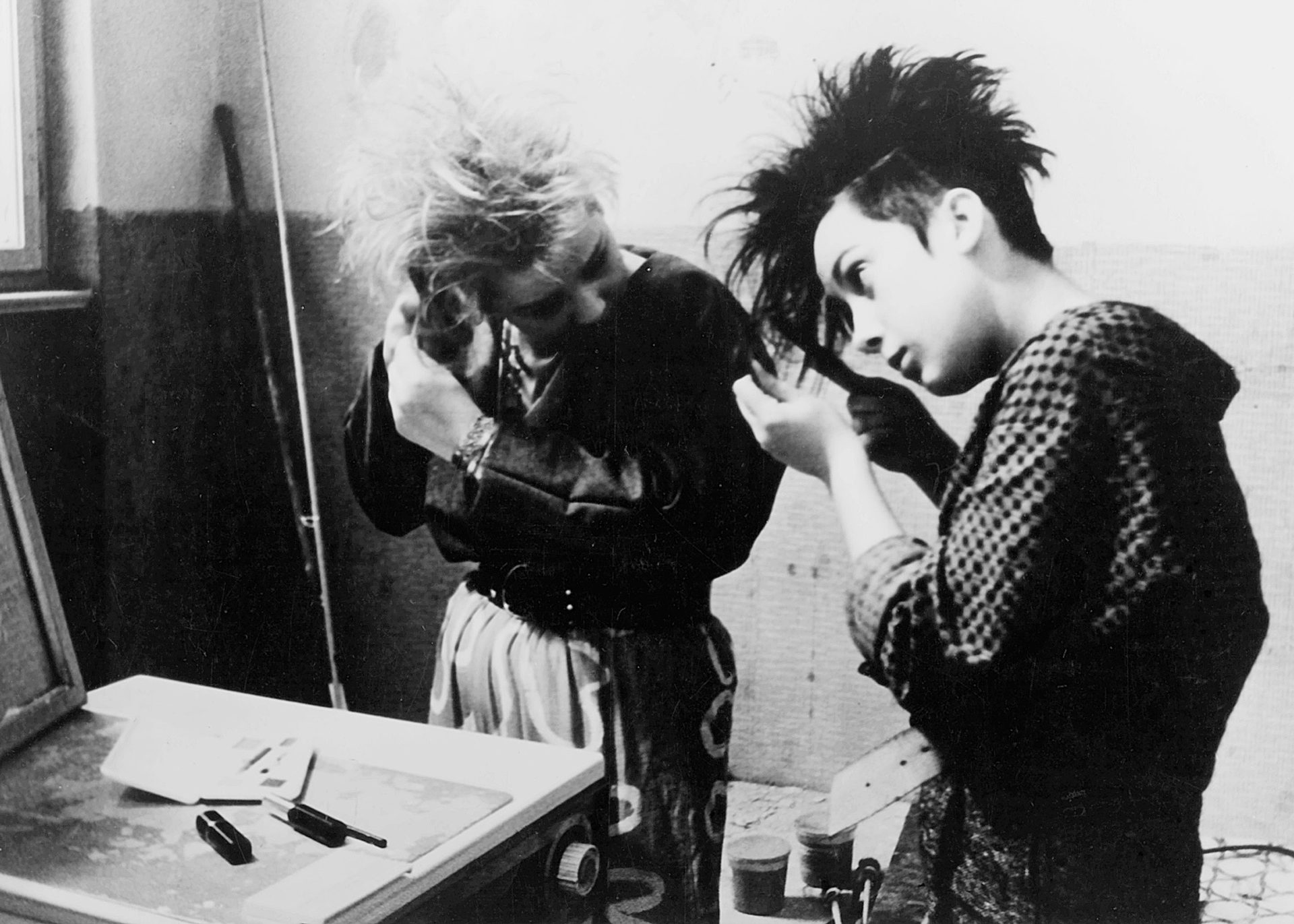
Welcome to a special screening Winter adé (Helke Misselwitz, 1988), a pioneering and illuminating group portrait of East Germany seen through the eyes of women. The screening is introduced by film scholar and curator Erika Balsom.
March 7 - 8th we present three screenings in collaboration with Human International Film Festival and Oslo Dokumentarkino as part of the exhibition No Master Territories: Feminist Worldmaking and the Moving Image.
Where
Cinema
About the film
Winter adé is a collective portrait of East German women and girls across generations, beautifully photographed on black-and-white 35 mm. Helke Misselwitz begins her film in the first person, relaying the story of her life over images of her birthplace. From there, she undertakes a journey that goes far beyond her own autobiography, traveling from one end to the other of the GDR, a country that would soon cease to exist. “I know many women whose longings and anxieties I share,” she says in voice-over as she sets out “to see how others have lived and how they want to live.” Through a series of intimate conversations that bridge the “I” and the “we,” Winter adé challenges official narratives of gender equality under socialism, installing in their place a polyvocal account of female experience that foregrounds contradiction, individuality, and historicity on the eve of an immense sociopolitical transformation.
Check out the connecting programs here and here.
Read more about No Master Territories: Feminist Worldmaking and the Moving Image.
Still: Winter ade©DEFA-Stiftung/Thomas Plenert
About the director
Helke Misselwitz is one of Germany's most important documentary filmmakers. Born in Planitz in 1947, she held apprenticeships as a carpenter and a physiotherapist after graduating from high school, then worked for nine years as an assistant director and director with East German television. Misselwitz made her mark early in her career as a documentary filmmaker, chronicling with great sensitivity and artfulness the citizens and society of East Germany in the years leading up to and following the fall of the Berlin Wall and German unification. She began her career by making short documentaries, before making her first documentary feature, Winter Adé, a pioneering and profoundly illuminating group portrait of East Germany seen through the eyes of women she encountered as she travelled through the GDR by train.
Winter Adé immediately established Misselwitz as one of the most gifted non-fiction filmmakers of her generation, a status confirmed by the films that followed, including Who's Afraid of the Bogeyman and Bulky Trash, both of which extended her interest in the lives and perspectives of those at the margins of East German society. With Herzsprung in 1992, Misselwitz made a bold leap into fiction filmmaking, retaining her deep social and political engagement while demonstrating stylistic flair and a talent for storytelling. In 1996, Misselwitz directed a second feature film, Engelchen.
Misselwitz taught for years at the Academy for Film and Television (now Film University) in Potsdam-Babelsberg, after which she began to focus on her own directorial work more actively again. Her most recent films have been portraits of the acclaimed (East) German photographer Helga Paris, followed by Die Frau des Dichters a full-length portrait of the Türkish artist Güler Yücel (1935-2020), produced for arte TV. Helke Misselwitz has been a member of the Academy for the Arts since 1991 and, since 2018, she has been the deputy director of the Academy’s division of film and media art.
About Erika Balsom
Erika Balsom is one of the curators of Kunstnernes Hus' current exhibition No Master Territories: Feminist Worldmaking and the Moving Image. She is a reader in Film and Media Studies at King’s College London. She is the author of four books, including After Uniqueness: A History of Film and Video Art in Circulation (2017) and TEN SKIES (2021), and her writing has appeared in publications including Cahiers du Cinéma, e-flux, Grey Room, and New Left Review. Her curatorial projects across the cinema and the gallery have taken place at venues including Haus der Kulturen der Welt, Kunstverein Hamburg, Spike Island, MAXXI, TIFF, and ICA London. In 2026, Columbia University Press will publish her criticism collection The Edges of Cinema: Essays on 21st Century Film Culture.
Title
Winter adé (After Winter Comes Spring)
Directed by
Helke Misselwitz
Country
German Democratic Republic
Year
1988
Duration
116 min