Intimate Portraits
Short film program introduced by Erika Balsom
Sunday 08.03.26
Sunday 08.03.26
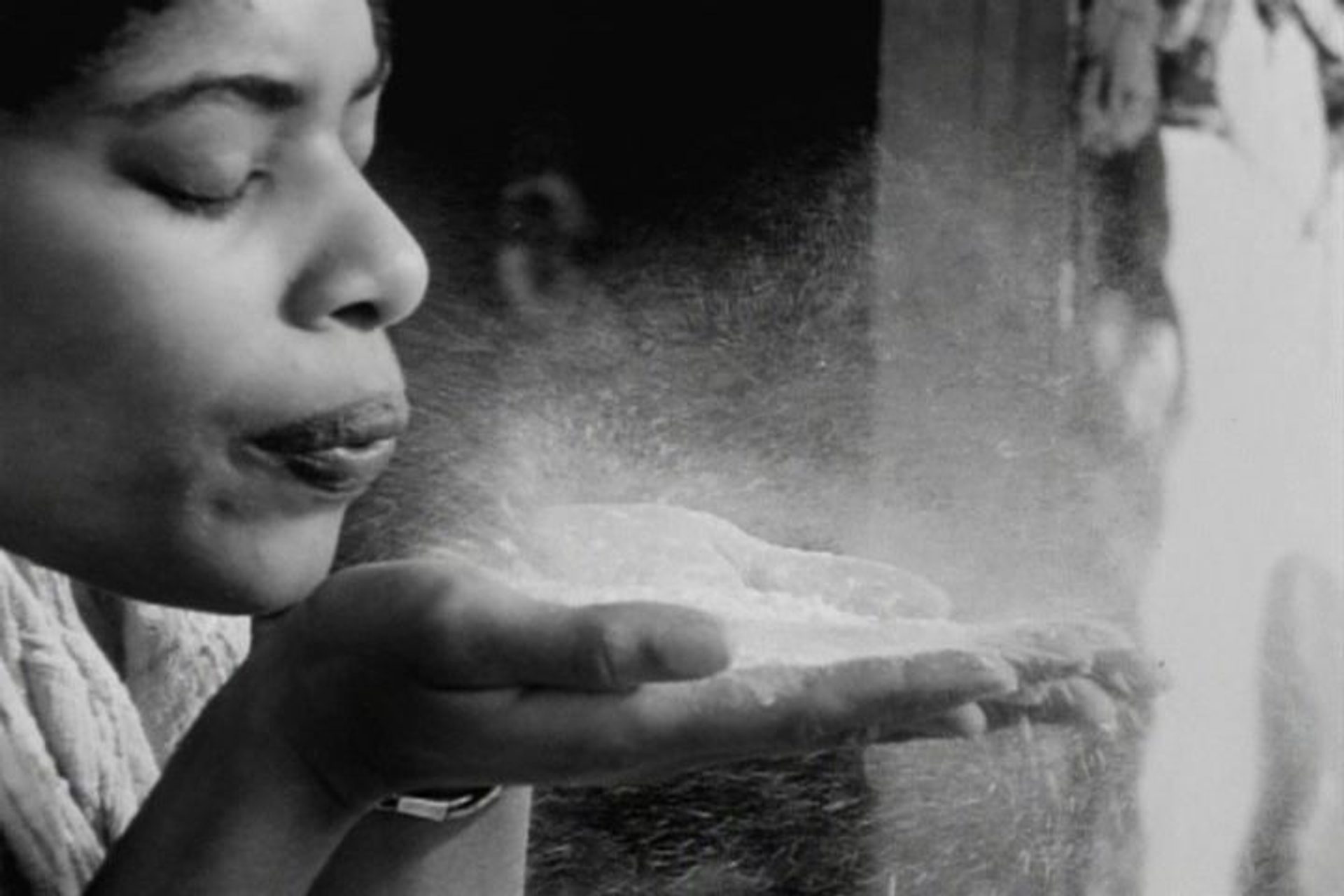
This selection of four experimental shorts exemplifies how feminist filmmakers across diverse geographical contexts have challenged traditional modes of female portraiture and reconceived of the relationship between filmmaker and subject. Whether it involves picturing the nude body of a friend, producing a fragmented representation of the self, or staging a confrontation with one's own image, these delicate and beautiful films claim the moving image as a site of subjectivity and relationality.
The program will be introduced by film scholar and curator Erika Balsom.
Films
Leslie Thornton, X-TRACTS (1975), 16 mm, 8:30 min., USA
Leslie Thornton’s first 16 mm film, X-TRACTS (1975), was made in collaboration with Desmond Horsfield. To generate the film’s soundtrack, Thornton began by reading from diaries from her adolescent years, and then subjected the recording to extensive editing, such that full words, partial phrases, and orphaned phonemes jostle together in glossolalic tumult. The film cannibalizes a private, stereotypically feminine mode of writing, so often held to be an unhampered transmission of innermost feeling, simultaneously making it public and mangling it beyond recognition. Meanwhile, at the level of the image, glimpses of life cascade forth in brief monochrome bursts, occasionally punctuated by spells of blackness.
Barbara McCullough, Water Ritual #1: An Urban Rite of Purification (1979), 16 mm, 6 mins., USA
Water Ritual #1: An Urban Rite of Purification was filmed in an area of the Watts neighborhood of Los Angeles that had been razed to make way for the construction of the Interstate 105 highway but was then left abandoned. Inspired by a friend’s mental breakdown and working in collaboration with performer Yolanda Vidato, Barbara McCullough explores the possibilities of transformation through the cleansing of the environment and of the self. According to the filmmaker, “Water Ritual is a beginning point in my quest to create cathartic experiences for myself and my community by the depiction of symbolic actions that communicate with our ancestral, spiritual past.” In its original version, the film featured multihued hand-coloring.
Maria Lassnig, Iris(1971), 16 mm, 10 min., USA/Austria
Iris is the first of four portraits comprising Soul Sisters, a series of films Maria Lassnig made while living in New York. Using an array of techniques including superimposition, stop-motion photography, distorting mirrors, and unconventional camera angles, the Austrian artist crafts an undulating and unfamiliar representation of the female nude, with her friend Iris Vaughan as subject. Best known for her work as a painter, Lassnig employed the term Körperbewusstsein or “body awareness” to describe her practice. Here, she carries over this approach into film, leaving behind a realistic depiction of the human form to better communicate corporeal sensation.
Narcisa Hirsch, Seguro que Bach cerraba la puerta cuando quería trabajar (Bach probably closed the door when he wanted to work work, 1979), Super 8, 27 min., Argentina
To make this film, Narcisa Hirsch shot a series of her friends in close-up, without sound, and then showed them the result and asked them to respond to their own image. Seguro que Bach cerraba la puerta cuando quería trabajar stages what might seem like a scenario of female narcissism, but transforms and complicates the encounter with the mirrored self through the presence of the filmmaker and the film apparatus. Hirsch repeated similar experiments three times, in 1974, 1979, and 2005.
Total runtime 51 minutes + introduction.
Check out the connecting screenings here and here.
Read more about No Master Territories: Feminist Worldmaking and the Moving Image.
Program for Human International Film Festival 2-8 March.
About Erika Balsom
Erika Balsom is one of the curators of Kunstnernes Hus' current exhibition No Master Territories: Feminist Worldmaking and the Moving Image. She is a reader in Film and Media Studies at King’s College London. She is the author of four books, including After Uniqueness: A History of Film and Video Art in Circulation (2017) and TEN SKIES (2021), and her writing has appeared in publications including Cahiers du Cinéma, e-flux, Grey Room, and New Left Review. Her curatorial projects across the cinema and the gallery have taken place at venues including Haus der Kulturen der Welt, Kunstverein Hamburg, Spike Island, MAXXI, TIFF, and ICA London. In 2026, Columbia University Press will publish her criticism collection The Edges of Cinema: Essays on 21st Century Film Culture
Title
Short film program: Intimate Portraits
Directed by
Leslie Thornton, Barbara McCullough, Maria Lassnig, Narcisa Hirsch
Duration
51 minutes