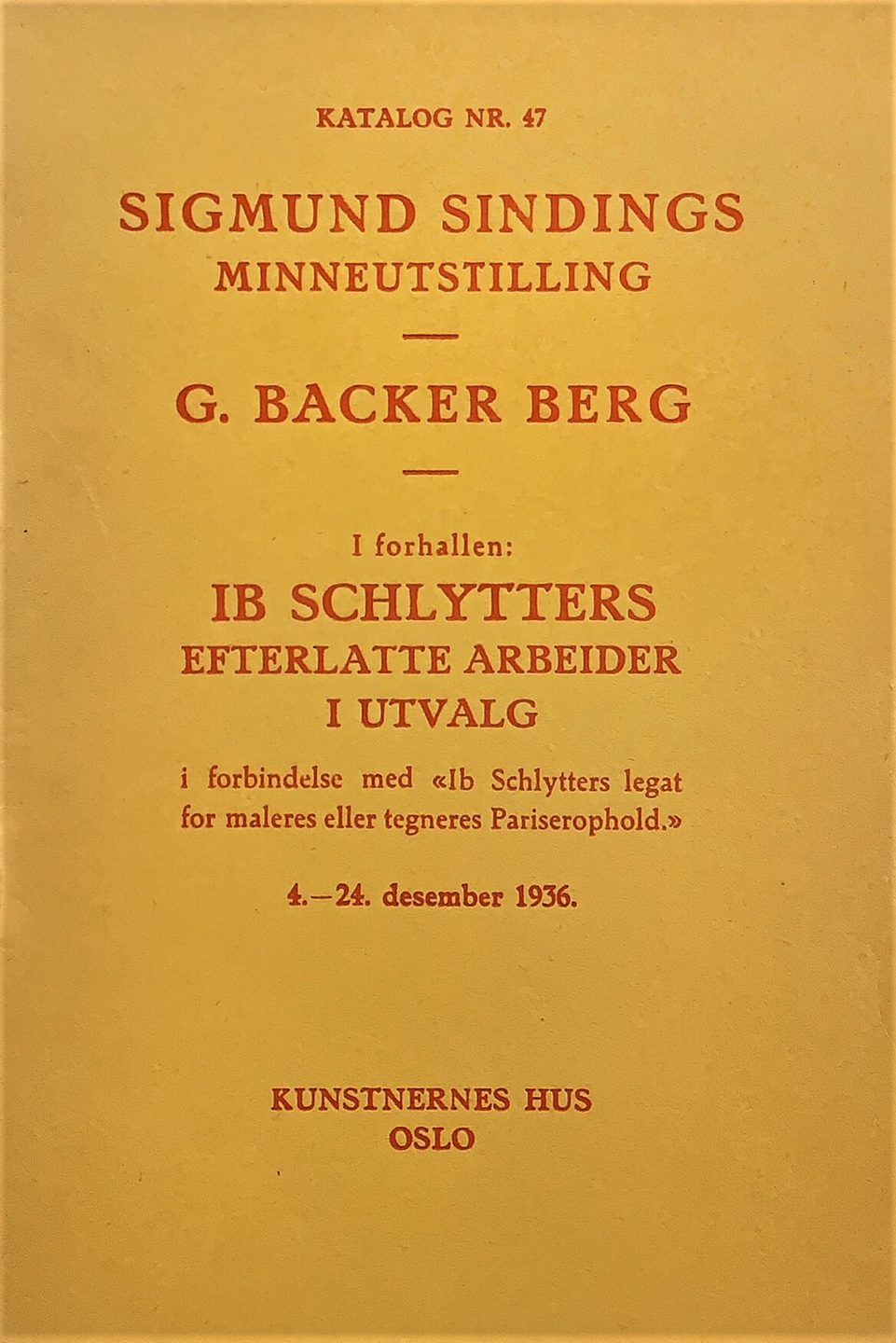
Sigmund Sinding, G. Backer Berg
04.12.36 – 24.12.36
Paintings
Sigmund Sinding
S. made his debut at the age of 19 at the Autumn Exhibition in 1894 with In the Twilight Hour the same year as Harald Sohlberg and Halfdan Egedius. At first he was most interested in the strict forms and lines of the Renaissance, Dürer, Holbein, Botticelli, also admired his teacher Erik Werenskiold, but his interest soon focused on Rembrandt and Velázquez. He copied the last one in Paris 1897–99. In these years, S. painted fantasy compositions, landscapes, interiors and portraits in the dark, romantic mood-seeking style of the time, but gradually in a somewhat lighter tonality such as in Summer Evening (c. 1901, National Gallery, Oslo). He did some of his best work in a series of portraits, mostly of relatives and artist friends (Stephan Sinding 1902, Otto Sinding 1904 Rasmus Meyers Samlinger, Bergen, Ragnhild Jølsen c. 1907 Aschehoug Forlag, Chr. Sinding Autumn Exhibition 1909, Peter Egge c. 1910 Den Norwegian Writers' Association, Ragna Wettergreen, Høstutstillingen 1915, Knut Hamsun1924, Hans E. Kinck, Torleiv Stadskleiv). S. settled in Stavern in 1903, lived at Nordstrand 1912–20 and later at Nesodden, but was often travelling. He took many of his motifs from Paris and Rome (St. Sulpice church in Paris 1920, National Gallery). He also liked to paint street scenes from Kristiania, in addition to interiors, often with children, and slightly melancholic forest and fjord scenes. In his last years, he concentrated on museum displays with old and precious things, matt-shining pewterware, Chinese vases, conch shells, figures and masks in bronze and ivory, alabaster and marble. In other pictures, he returns to the elegiac fantasy art of the 90s (The Princess), but without being capable of a painterly renewal. His colors are often disharmonious, applied dry and mechanical. S. had a combative nature and was happy to join in newspaper polemics. As early as 1903, he attacked the Lysaker painters with accusations of camaraderie, and until his death he lived in constant feud with the misunderstanding critics, especially Jappe Nilssen, i.a. in the form of small printed pamphlets.
G. Backer Berg
B. made his debut at the Autumn Exhibition in 1920 and held his first solo exhibition at Stavanger Kunstforening in 1921. Around 1920 he was taught by Lhote student Bjarne Hansen, who mediated the contact between his students and the highly admired French "semi-cubist". After his stay in Paris in 1925, B.'s painting was for a number of years characterized by the strong impulses he received from his teacher Lhote and from Picasso, Braque and Cézanne. Until the mid-1930s, his pictures have an aestheticizing touch. They are often very summary in their stylized neoclassical design, with a relatively deep-toned color that is characterized by a refined play of muted denominations.
After 1935, however, B.'s art gradually acquired a less strictly theoretical, more natural feel. Beyond the 1940s, his form became freer and more personal, the color tone brighter and richer. B.'s range of motifs is extensive. He has painted landscapes, city and harbor motifs (often with figures), figure compositions, genre motifs, interiors, flower motifs and still life. His best works testify to a confident composer and discerning colorist with distinct artistic abilities.