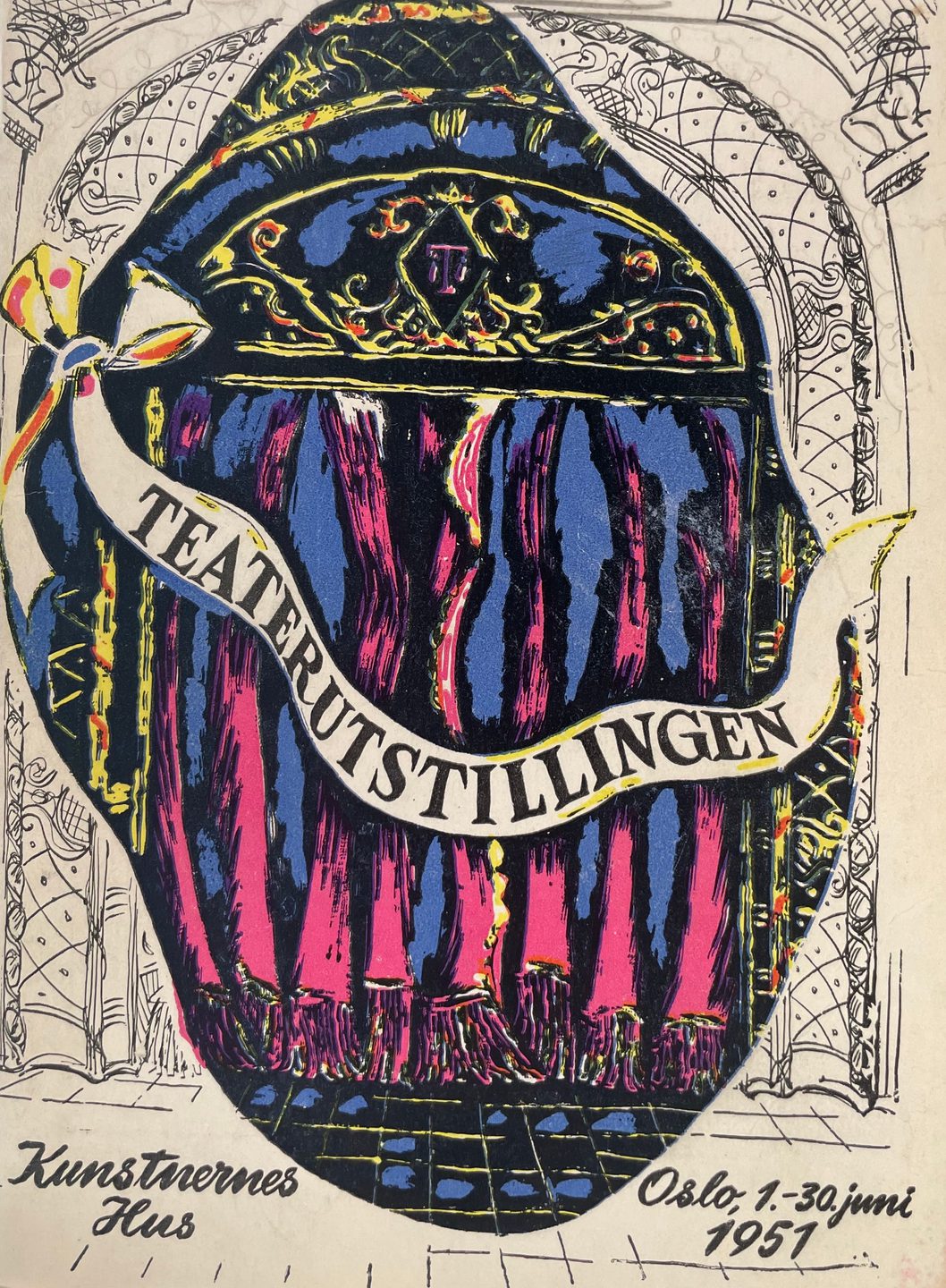
The International theatre exhibit
01.06.51 – 30.06.51
International art
This, the first international exhibition of contemporary scenic art and stage décor is an event in the history of the theatre. The Norwegian Theatre Union are gratified that Norway should have been chosen as the venue for exhibition, while the organizing committee are delighted at the scope and high quality of the exhibits.
Most countries with rich theatrical traditions are represented, though we regret that a few countries who have made an important contribution to the development of scenic art and stage décor e.g. Russia, are not with us on this auspicious occasion. We are especially happy to welcome the French exhibitors whose section so worthily represents a country with old and venerable traditions in the sphere of stage décor.
The art of the theatrical designer is an old one, but his impor tance has never been greater than in the last half century. Never before has the modern stage presented such a variety of drama; those responsible for the artistic side of stage production are faced with the exacting task of cooperating with the scenic ar€ist to produce a background to the words of the author in harmony with the atmosphere of the play, its milieu and the intentions of the playwright.
In days gone by, stage productions were far more rigid and more. standardized: from the origins of the drama and up to the beginning of the nineteenth century what might be called stage architecture played a more important role than scenic décor, and even in the last century the work of the scenic artist was not so much an art as a craft.
The theatre's selection of stage décor was narrow and some-what uniform. There are some who consider that the olden days were best because the spoken word of the actor suffered no competition from the other scenic arts.
There are admittedly producers and stage painters who eclipse the spoken word with their elaborate devices and dazzling' lours, thus obscuring rather than emphasizing the intentions of the playwright, but generally the spoken word does receive greater prominence than ever before.
A producer and scenic artist should have imagination, taste and discretion; his imagination should assist him to interpret the intentions of the author as accurately as possible leaving no scope for his own personal idiosyncrasies. A production may resolve itself into a tug of war between the playwright, the producer and the scenic designer, but it can also achieve a fusion in perfect harmony.
Modern scenic design has undoubtedly given theatrical production beauty and variety, providing a feast for the eye, and a rest for the mind which were sadly lacking in the oldtime theatre. A conflict may just as easily arise between the scenic designer and the actor, for the same lighting effects are not equally flattering to the players and the settings in which they perform. It is just as important to avoid a clash of costume and décor.
The scenic painter is primarily responsible for achieving the harmony and the adaptability which the drama demands by means of his professional knowledge of the stage. In approaching our subject we must also distinguish between the easle-painter who occasionally paints for the theatre, and the stage-painter who is a scenic artist by profession, though the latter may well try his hand at easle-painting from time to time.
The easle-painter's forte lies in colour and composition, whereas his weakness tends to lie in the purely technical. From the point of view of the theatre the ideal would be a scenic artist who, apart from his technical knowledge and his practical knowledge also possessed a delicate sense of colour. The same result can of course be achieved by an easle-painter who has completed his apprenticeship in the school of decorative art and acquired the technique necessary the profession of the scenic painter.
Visitors will here see both types of theatre painting: generally at an exhibition such as this one the scenic painter or show to best effect in model sets, and the easle-painter in colour sketches. A man connected with the theatre once said that the best décor is the one which disappears, that is to say, the one which the audience hardly notices. This may be a slight exaggeration, but one thing is certain: a décor should never obtrude to the disadvantage of the dialogue, the action and the acting.
A décor should present a richly varied but harmonious setting to the actor's interpretation of their roles, in such a way however, that its removal or substitution by a different setting would detract from the general effect. In some productions the décor may even be expressly used to strike a jarring note, provided this is achieved with delicate and conscious artistry.
The position of the painter and costume designer has become so important that many scenic painters not only design the costumes, but even appear as fully fledged producers. On the other hand it happens that the producer suggests the décor and even in some cases paints it himself. Production has become increasingly the result of intimate cooperation between the various arts. At all times, however, it is well to remember that the word and its interpreters are the «be all and the end all» of the performance.
On behalf of Norsk Teater Union I extend a cordial welcome to all exhibitors and visitors to the exhibition.
Axel Otto Normann, President of Norsk Teater Union