Passage Without Promise
12.03.26 – 15.03.26
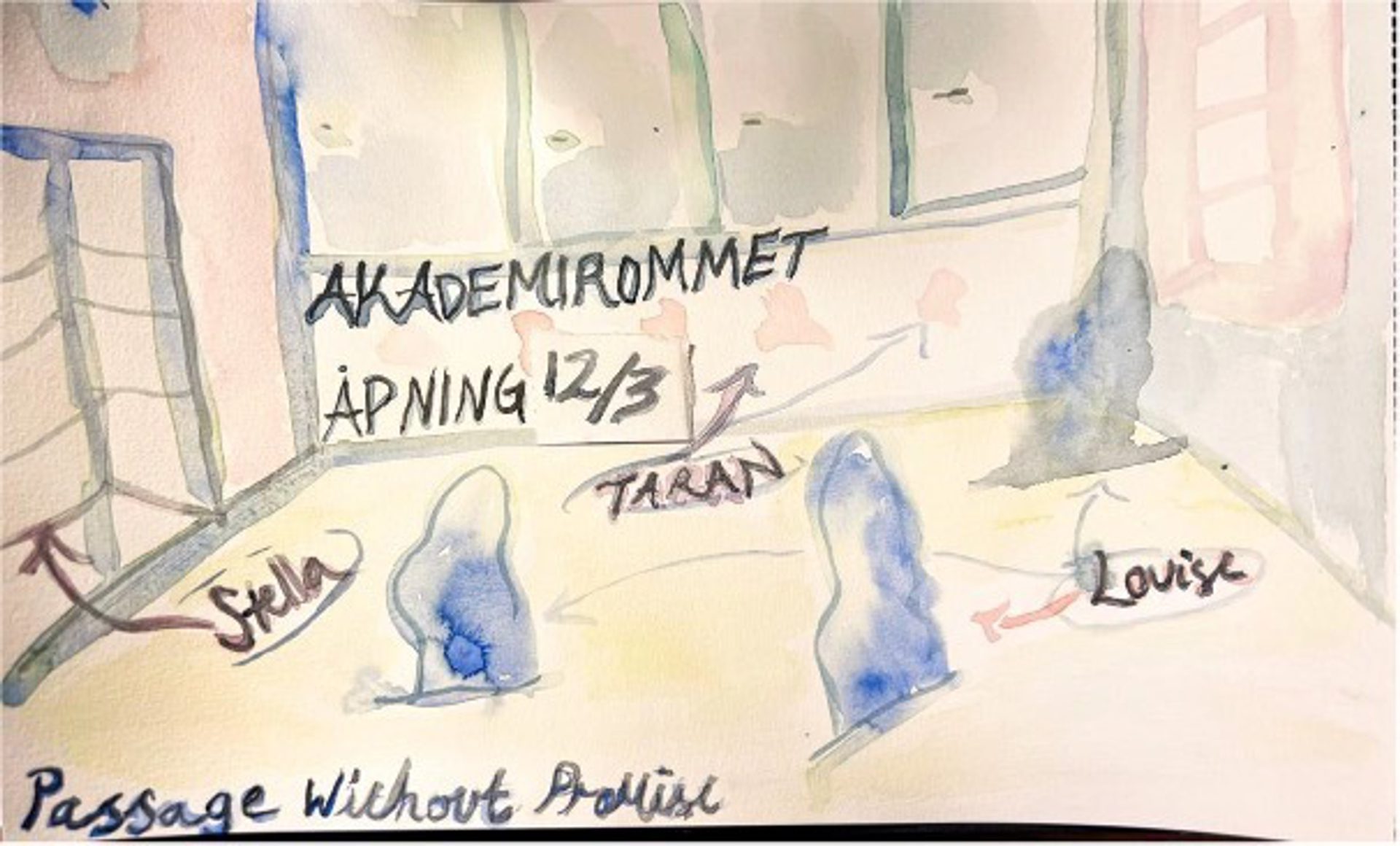
Passage Without Promise brings together sculpture, installation, text, and material fragments to build an immersive environment shaped by sensory attention and open narratives. The exhibition consists of containers that are visible, yet not fully accessible. Through material research and craftwork we invite the audience to observe and pay attention, but without promising easy answers and solutions.
About the exhibition
Fragments of the domestic, the industrial, and the non-human coexist without hierarchy, functioning as narrative guides rather than completed stories. Meaning emerges through passage, repetition, and interaction rather than explanation. Absence carries equal weight to presence.
The space reflects a shared condition of human searching within systems that remain partially unseen, uncontrollable, and unresolved.
This exhibition is a meeting place for our different artistic practices, each rooted in its own form of expression: printmaking as a traditionally flat, two-dimensional medium; metal as a hard material, often shaped sculpturally in relation to its surroundings; and jewelry art, which is typically worn on the body as intimate objects.
However, we are merged by a shared, material-focused approach to process, surface, and form. Across our different disciplines, we are engaged in storytelling, inspired by Ursula K. Le Guin’s Carrier Bag Theory of Fiction, which guides us in creating sustainable, open narratives.
About the artists
Stella Vallik (b. 1996, Copenhagen, Denmark)
"I work with various printmaking techniques, text, installation, and drawing to create narratives of alternative worlds. In these universes, the boundaries between species and bodies dissolve, and humans are no longer at the center. Through craft and material investigation, I create speculative fiction; it is a form of knowledge production that explores possibilities over facts.
My practice is rooted in posthumanist theory and is a response to the sixth mass extinction: an unfolding of planetary grief over lost biodiversity. My primary aim is to evoke a felt attention and a radical curiosity toward the species with whom we share the planet."
Louise Evensen Herreira (b. 1993, Stockholm, Sweden)
Louise Evensen Herreira is an Oslo-based artist working with metal, sculpture, performance, and installation. She holds a BA in Medium- and Material-Based Art from Oslo National Academy of the Arts and is currently completing her MFA.
Her practice is rooted in material exploration and narrative observation. Working primarily in metal, she develops a sculptural language that balances technical precision with sensitivity to
context, atmosphere, and the body. Much of her process unfolds in public space through walking, collecting, and listening, tracing urban transformations and their residues.
Evensen approaches objects as ethnological and archaeological material — carriers of cultural, emotional, and social layers. Her work moves between sculpture, performance, and installation, where making becomes a physical form of thinking: a way of sensing the world, negotiating its tensions, and allowing the surreal to surface.
Taran Helene Graff (b. 1989, Bærum, Norway)
Taran Graff works at the intersection of jewelry art, body-related objects, sculpture, and installation. Her practice revolves around the cycles of the body and nature, with a particular focus on fertility, the female body, and the interconnected relationships between humans, the sea, and the moon.
Through materials such as stone, glass, metal, wax, textile, and enamel, Graff explores how life, transformation, and vulnerability can take material form. The works move within tensions between soft and hard, transparent and impenetrable, living and static — allowing contrasts to coexist and negotiate with one another.
Sensory experience is central to her practice. The works invite touch, presence, and slow discovery, seeking to create spaces of wonder where material transformation mirrors the body’s own rhythms and the subtle movements of nature.
KHiO QuARTerly
The three visual departments at Oslo National Academy of Arts (KHiO) — Art & Craft, Design and the Academy of Fine Art host a public program at Akademirommet at Kunstnernes Hus during March, April and May.
Join us for exhibitions, events and workshop-presentations related to the departments’ study programs, brought together under the umbrella of KHiO QuARTerly.
Akademirommet is located in the back of Kunstnernes Hus in a former professor studio and classroom that has been used by the Academy of Fine Art intermittently since the 1930s.