Leonard Rickhard
04.02.95 – 12.03.95
Leonard Rickhard
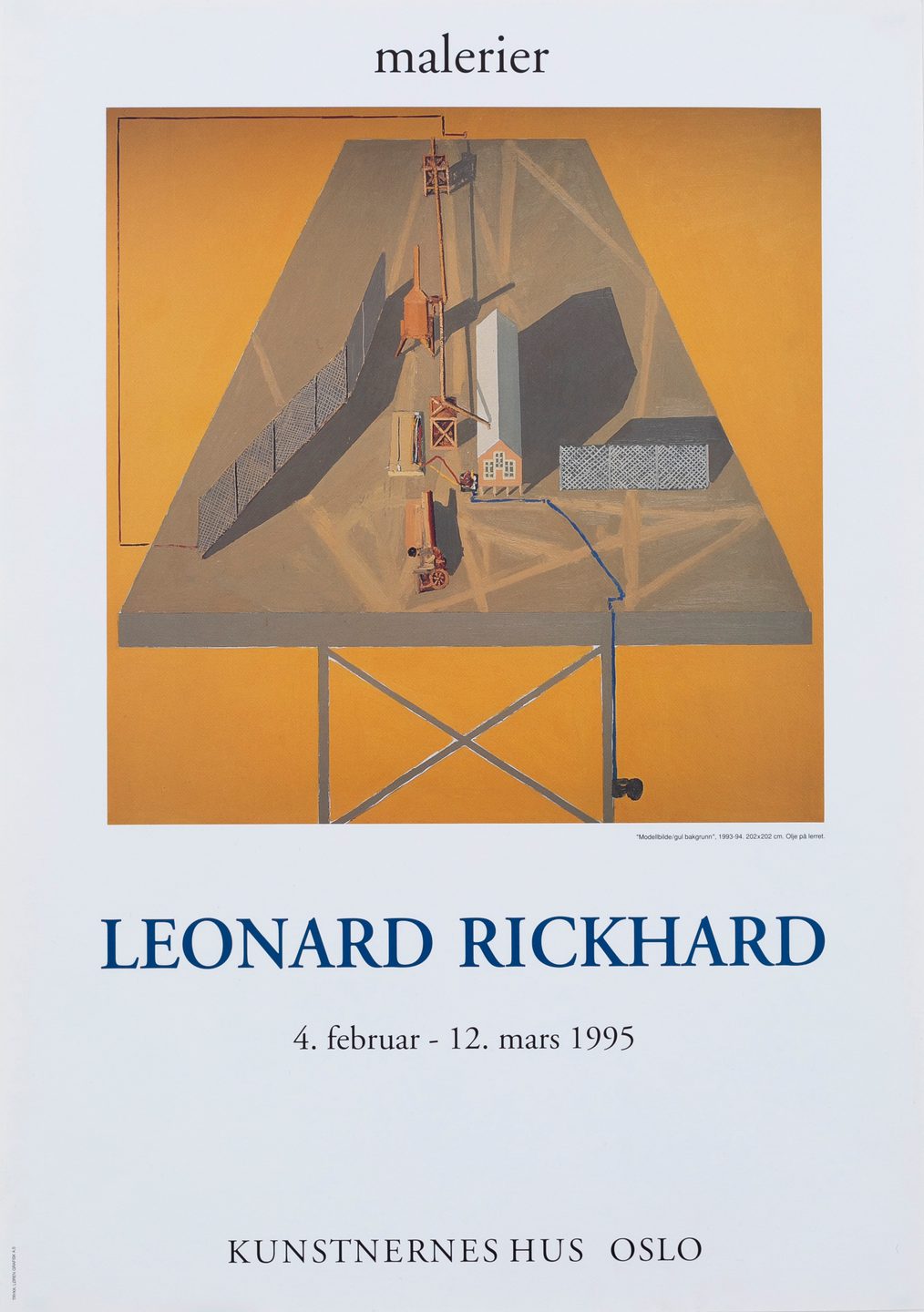
On the exhibition
A solo exhibition resulting from a collaboration between Kunstnernes Hus and the artist himself. During the preparations for the exhibition, Øivind Storm Bjerke and Åsmund Thorkildsen made a number of visits to Rickhard's studio in Arendal. Thorkildsen served as the exhibition's organiser, while Storm Bjerke had expressed an interest in a potential publication relating to Rickhard's art. A catalogue was published in conjunction with the exhibition, containing research contributions from both art historians.
From the catalogue
"The first problem raised by Rickhard's art in relation to the centre-periphery problematic is that of painting as a practice at the close of the twentieth century. Rickhard's painting is imbued with a conviction that he has chosen the right medium for what he wished to express – a conviction which, combined with an unqualified devotion to painting and a solid technical ability, lends his works an immediate authority. Rickhard's confidence in this choice reflects the strong tradition of painting in Norwegian art history – a tradition that only today is confronted with the challenges painting faced in the major centres during the 1960s. Norwegian artists of Rickhard's generation were, to a limited degree, exposed to the temptation to move into other media such as conceptual art, Arte Povera, environment or performance. Supported by local preferences and the prevailing self-understanding, one could overlook one of the most central issues outside the local milieu: the definition of painting's place among the pictorial media and in art as a whole. Measured against the image of international contemporary art, Rickhard's artistic practice – and with him the majority of Norwegian artists' practices – appears as a denial of, and an attempt to operate independently from, the various endeavours within that part of the art system which continues to function on the assumption that it holds a hegemony – and through this, constitutes the centre to which all other artistic activity must relate, or risk being branded provincial and anachronistic."
Øivind Storm Bjerke, 'Life along the southern highway – A study in Leonard Rickhard's painting'.
"Leonard Rickhard's paintings are built, in the traditional sense, on a classical painterly problematic: the relationship between depth and surface, and in particular figure and ground. By defining painting as a game, these concepts are transformed into player and field, or piece and board. Let us pause briefly at the concept of 'field'. This is what in English is called 'field', and as such is of great importance in Clement Greenberg's analyses of late modernist painting. Field is also the word used for the entire area inhabited by the Other, which in Lacanian thought is the arena of the play of signs, as part of the dialectic that makes human formulation and identification possible. But the concept of 'field' is also used for the areas of a football pitch, in Norwegian and other European languages. Let us be bold enough to allow the metonymic and metaphoric impulses here to play out, and draw a comparison between the arena and discourse of painting – canvas and frame – with the arena and discourse of football – grass pitch and touchline. From this comparison one may draw in the ornamentation of the stands as playing a role analogous to the more neo-mannerist versions of picture frames seen in postmodern art, with clear manifestations in Norway as well. Field, through its use in European languages, is linked to the word 'mark' – the demarcated area that is prepared, ploughed, to bear the fruits of the earth."
Åsmund Thorkildsen, 'The original work – clockworks – wonders. A theoretical investigation of the structure of Leonard Rickhard's model paintings.'
(Translated from Norwegian)
About the artist
Leonard Rickhard (1945–2024) was a Norwegian painter who lived and worked in Arendal. He participated in an earlier exhibition at Huset in 1981, as part of a group of 27 young painters. His Norwegian art collective Gruppe Zink, also presented a group exhibition in 1985. Recurring motifs in his body of work included birch forests, models, construction work and fragmented landscapes.