Joseph Kosuth og Amerikansk Konseptualisme
14.10.95 – 12.11.95
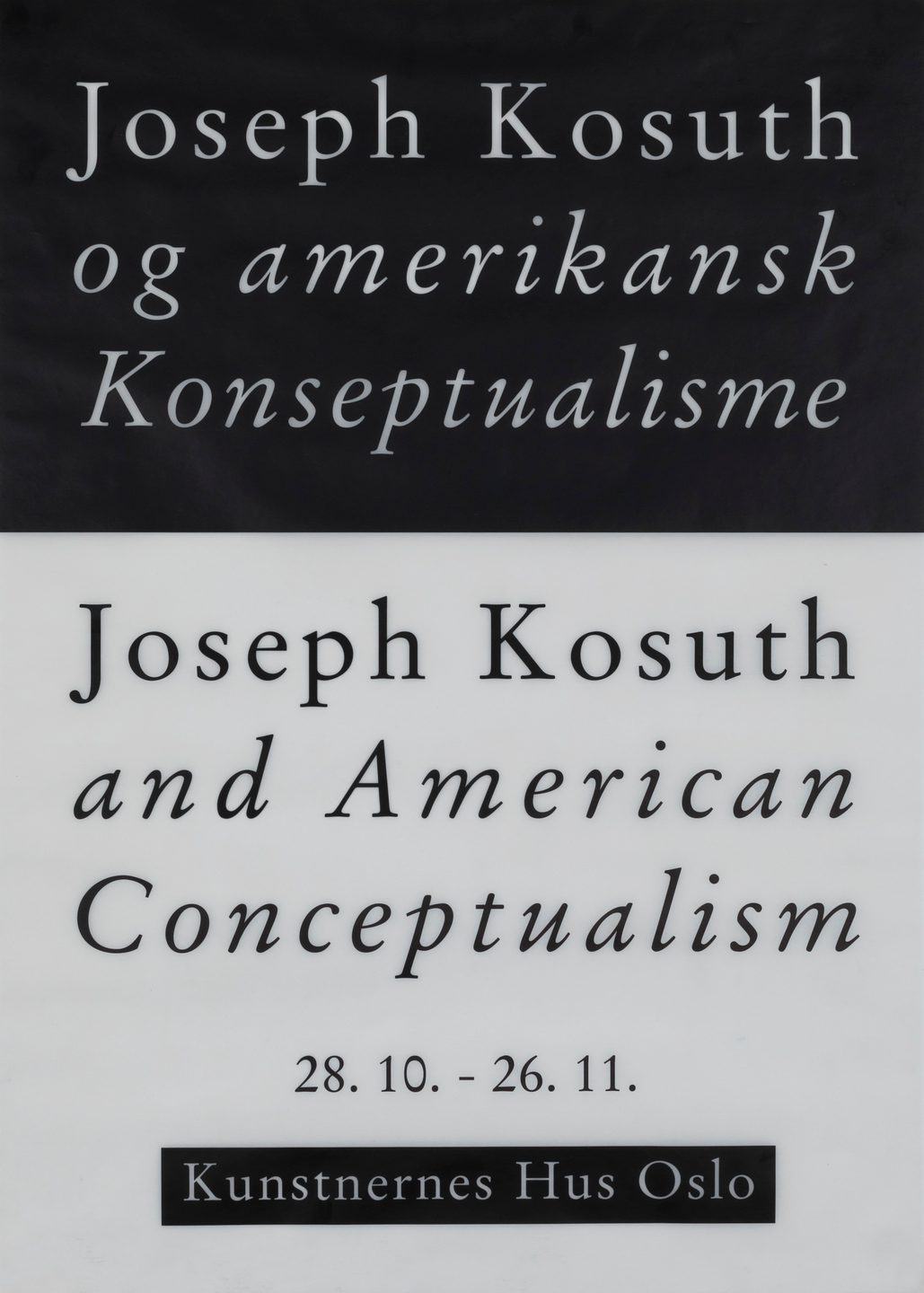
Joseph Kosuth and American Conceptualism
On the exhibition
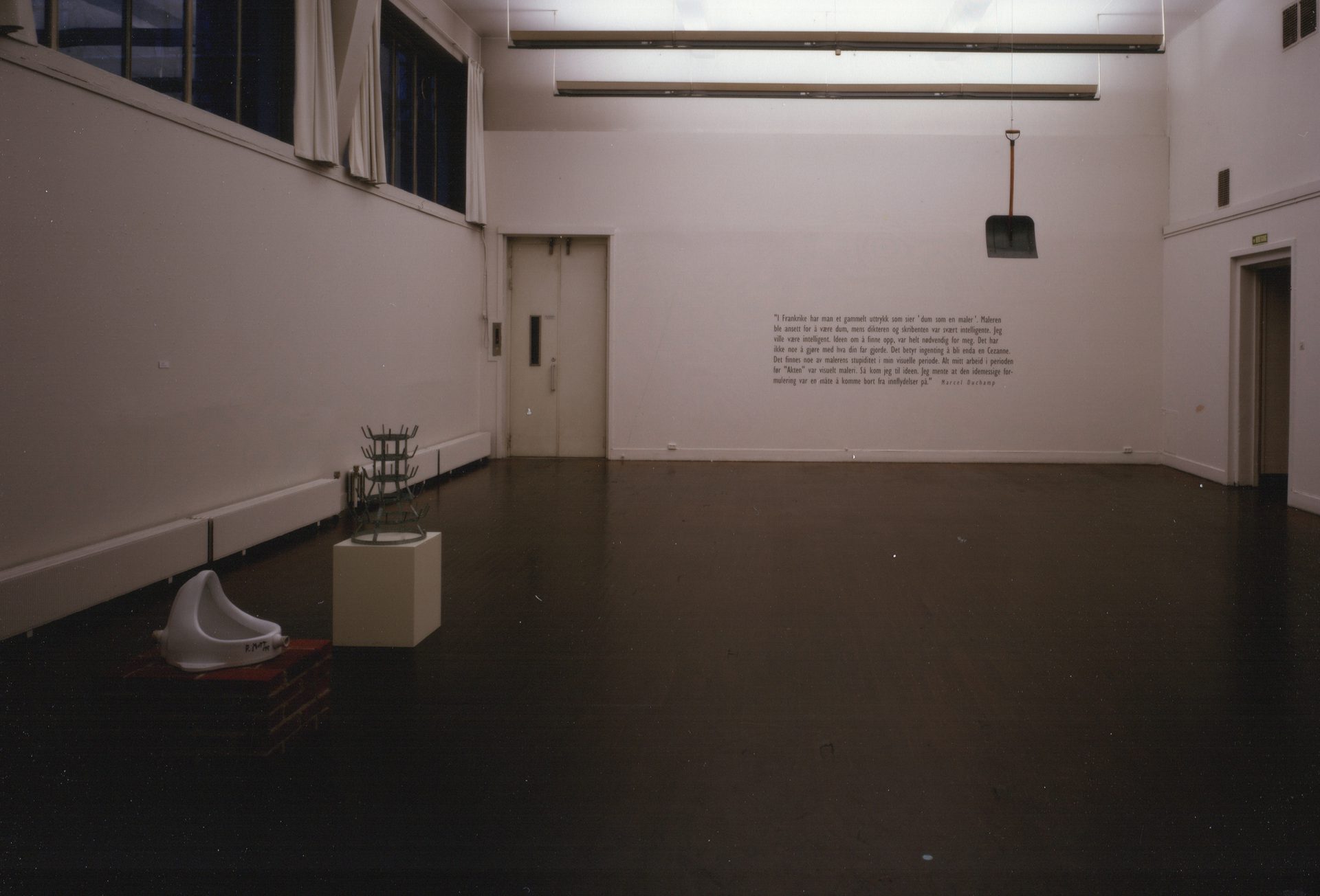
The exhibition contained several works by Joseph Kosuth, and served both as a presentation of his artistic practice and as an account of the emergence of conceptualism. Huset invited Kosuth to Oslo, where he created a new installation in which all texts in the works had been translated into Norwegian. The installation Guest and Stranger – Pattern and Meaning in the right Skylight Hall was made specifically for Kunstnernes Hus. In addition to Kosuth's work, the exhibition included works by, among others, Dan Graham, Michael Baldwin and Marcel Duchamp.
From the catalogue
"The first thing one must do when approaching conceptual art is to form an idea of what conceptual art is not. It is not concerned with the production of aesthetic objects. Conceptual art breaks with all art in which a gifted person shapes a material into beautiful or expressive objects. We therefore find no paintings or sculptures in conceptual art, neither traditional nor modern. All painting and all sculpture address themselves first to the senses, and artworks are sought out and experienced because they are individual and unique expressions of an artist's desire to express something. Traditional art can be seen and enjoyed; conceptual art must be read and thought through. Ordinary art can be seen as something experienced by the senses, 'perceptually', while conceptual art is tied to ideas and concepts, to the 'conceptual', to that which cannot be grasped immediately and cannot be captured in a single, unchanging expression. Conceptual art therefore demands something different of the viewer than other art. The conceptual artists were themselves willing to change their attitude both to making art and to being an artist. Their thorough break with the common understanding of what art is also means that the audience must be willing to adopt a somewhat different position than the one they are accustomed to.
(...)
Let us look at some of Joseph Kosuth's early works, which have been reconstructed for this exhibition. 'One and Three Chairs' from 1965 is the most famous of all Kosuth's works. It was included in Information in 1970, and was subsequently acquired by the Museum of Modern Art in New York, where the exhibition had been held. This work is one of his proto-investigations. Other everyday objects treated as 'one and five' included tables, walls, clocks, hammers, saws, and so on. These works demonstrate Kosuth's interest in analytical philosophy, and are often seen as demonstrations or models of tautologies; a chair is a chair is a chair... These are thus examples of the kind of art Kosuth argues for in his essay 'Art After Philosophy'; this is art that is self-explanatory as analytical propositions or definitions.
(...)
What makes it important to present a major exhibition of Joseph Kosuth and American conceptualism now is partly that his work is the most consistent and most radically developed within conceptual art. Partly also that one today sees a strong resurgence of conceptual practice among younger artists, as well as in the exhibition practice visible not least at Kunstnernes Hus in recent years, both through our own exhibitions such as 'Nettverk' and 'Per Palle Storm', and the last two years' Autumn Exhibitions. For obvious reasons, there was no conceptual art in Norway in the 1960s and 70s, partly because there was no situation of comparable tension to react against as there was in the United States and on the continent. And when young artists like Kosuth exhibited around 1970 in Holland, Germany, Denmark and Sweden, Norway was not on the itinerary. Among today's Norwegian art students and younger artists one sees a strongly growing interest both in conceptual art and in the kind of photography and installation art that followed in the 1980s. The problem both for artists and for those who mediate contemporary art in Norway is working in relation to a field that has never taken root here or indeed existed here at all. With the exception of a few artists who in the 1970s had contact with conceptual art abroad, it is as with so many other areas: a void in our recent history. This exhibition therefore marks Kunstnernes Hus' desire to place conceptual art on the agenda now that it is once again highly relevant. In this way we may be able to create at least one fixed point and one important reference, both for navigating the diversity that is continually being created around us, and for becoming acquainted with some foundational concepts from which we can begin the discussion."
Åsmund Thorkildsen
(Translated from Norwegian)
About the artist
Joseph Kosuth (b. 1945, Ohio) is an American visual artist and writer. He is a key figure within conceptual art, and his works have been significant for the development of the curatorial role, demonstrating that the meaning of a work can change depending on where and how it is presented. His best-known works formed part of the series 'Proto-investigations' from the 1960s, in which everyday objects were presented as a physical thing, an image, and a linguistic definition.