Frans Widerberg
Malerier: 1980-1990
10.03.90 – 11.04.90
10.03.90 – 11.04.90
Frans Widerberg - Malerier: 1980-1990
The Exhibition
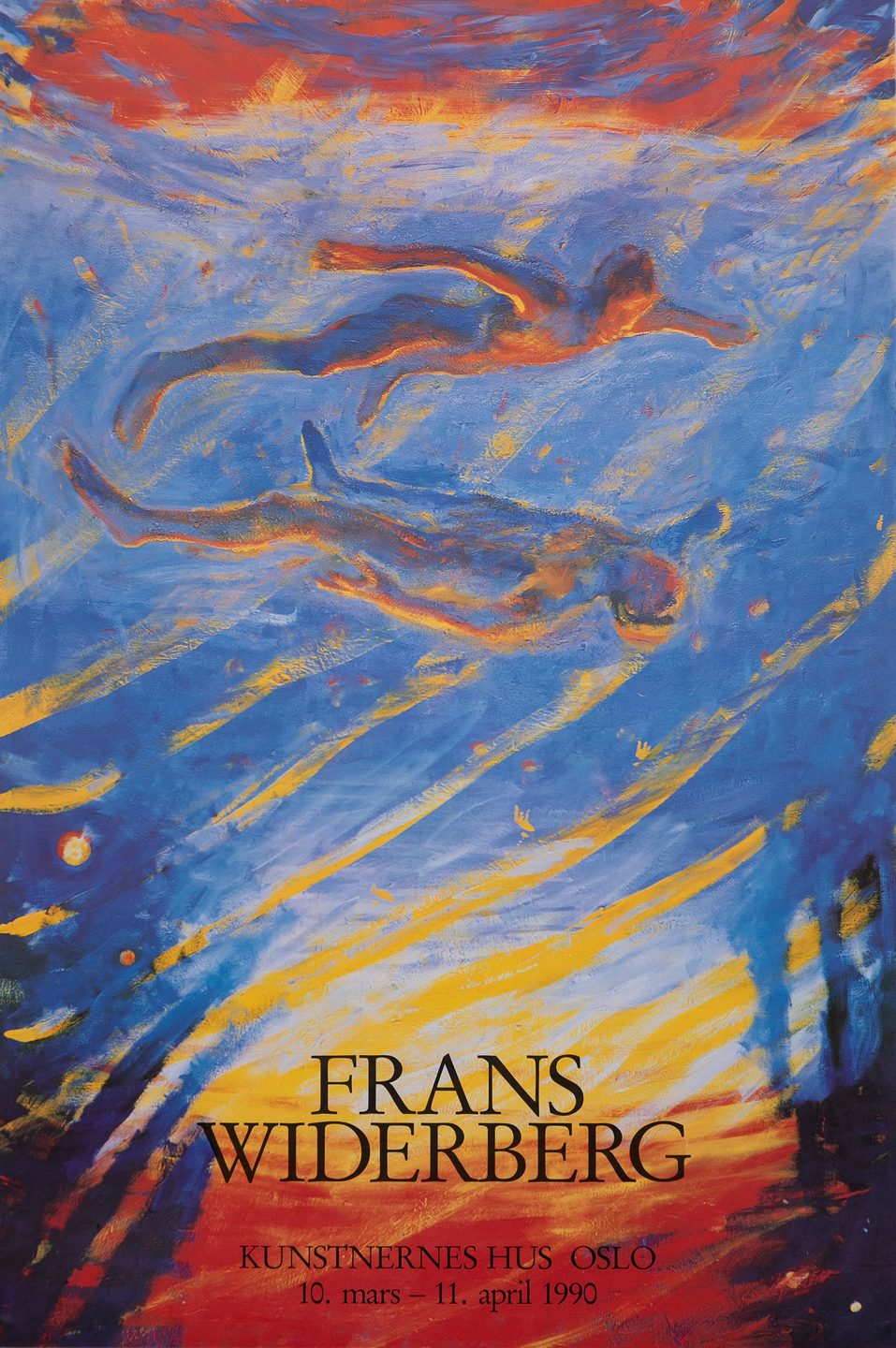
In 1990, the exhibition Frans Widerberg - Malerier : 1980–1990 (Paintings: 1980-1990) presented a selection of the artist's work from the years 1980–1990, with a focus on human forms and motifs. The exhibition poster features the work Comet Portrait, painted by Widerberg during 1986–89.
From the Catalogue
“An examination of Frans Widerbergs’s art can well begin with the question: “Is man made for this world?”. This is a big question, and one which preferably should be answered by the affirmative proclamation “Yes, man is made for this world!” In the work of Frans Widerberg this affirmation often takes the form of testimony stating that all is exceedingly well. But the transcendental ecstacy of this testimony wouldn’t have been possible without The Fall and the ever-present gnawing anxiety caused by this question.
In this introduction it is tacitly understood that Frans Widerberg is no oddball. His vision and working method could well appear as extremely challenging to a somewhat narrow-minded, modernistic Norwegian art milieu in the 1960’s, but in hindsight it becomes clear that Widerberg’s artistic vision has many parallels in both the near and distant past.
Widerberg is a romantic. Many will maintain that he has developed into an expressionist, but Frans Widerberg has been first a romantic and then an expressionist, right up to today. Looking at his pictures, one sees man portrayed both in the most vulnerable and triumphant situations. Such is man in the eyes of artists and poets. Frans Widerberg has spiritual ancestors in several centuries of romanticism, in existensial philosophy and in modern poetry.
The fact that we have previously encountered soaring, hovering and drifting man makes it possible for us to recognize them in Widerberg’s art. William Blake and John Milton would recognize themselves in his pictures; Lars Hertervig and Søren Kierkegaard would recognize themselves, and so would T.S. Eliot and Cecil Collins. And we too recognize ourselves – through all of these.”
The exhibition was the result of a collaboration between the artist himself, Kunstnernes Hus, and the Ministry of Foreign Affairs, and aimed to "make the artist's work [...] more accessible to an international audience and thereby also create understanding and interest in Norwegian art and culture." Then museum director Åsmund Thorkildsen informed Drammens Tidende on March 17, 1990, that more than 2,000 visitors attended the opening of the exhibition to see the 43 selected paintings. Following its stay at 'Huset', the exhibition was to be shown in a number of other European countries.
About the artist
Frans Widerberg (1934–2017) was a Norwegian painter, graphic artist and illustrator. He was educated at, among others, the National College of Art and Design (1953–55) and the National Academy of Fine Arts (1957–59). Through his art, he addressed central questions about life, inner contradictions, ambiguous answers, and enigmatic mystical hints. Reflections on his own powerful experiences in nature were also central to many of his works. Widerberg depicted a centuries-old romantic tradition of the inherent nature of man, with brushstrokes and colors belonging to a more modern era. He typically used primary colors, never mixed with white or black. In 1998, his painting Water Rider (1980) was reproduced on a postage stamp, in the series Contemporary Art.