Erling Enger
15.06.91 – 11.08.91
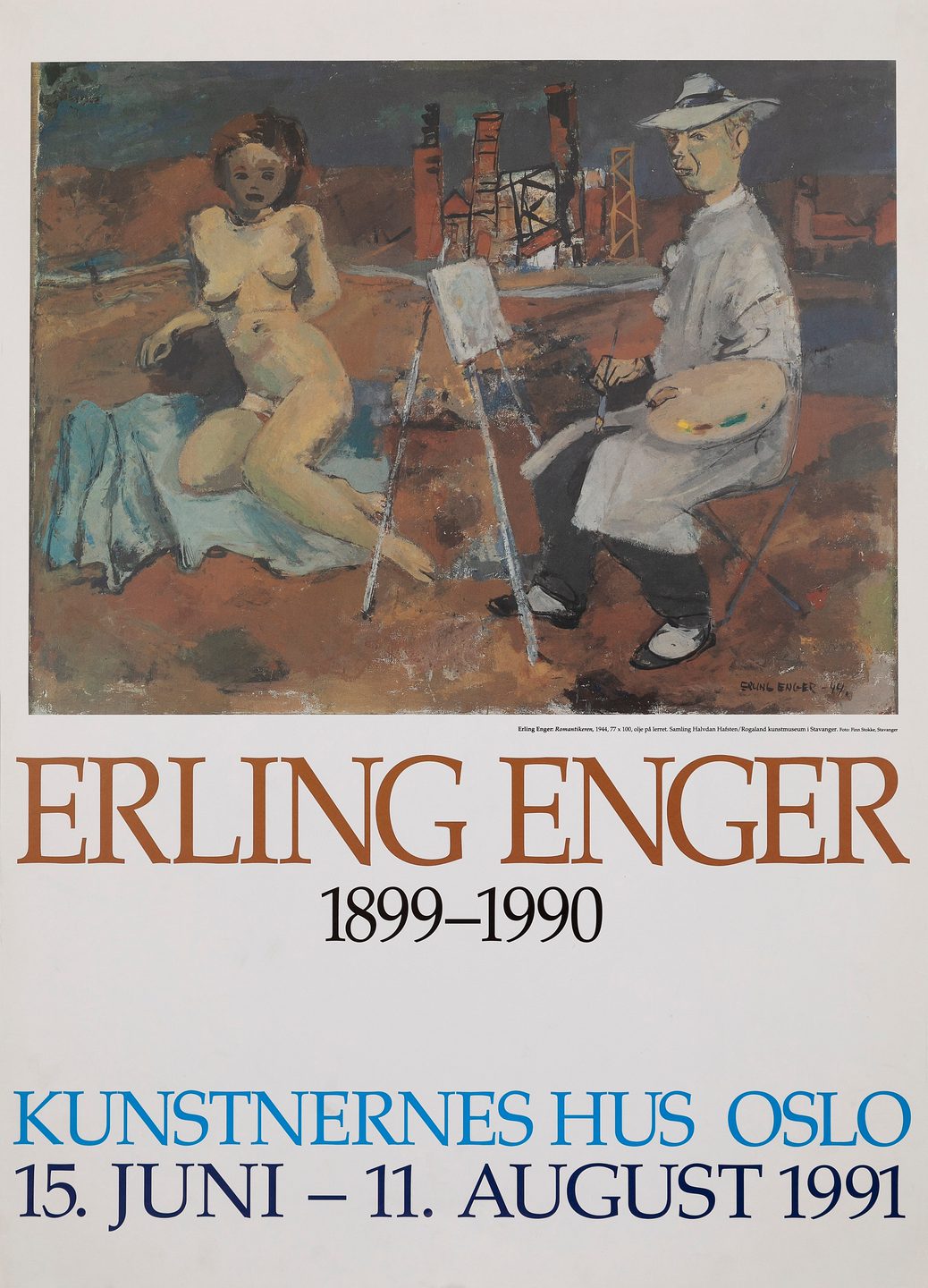
Erlinger Enger 1899-1990
The exhibition came about as a tribute to the artist following his death in 1990, and originated in the recognition that a substantial and representative presentation of his work had long been absent.
From the catalogue
«I don’t know any other way except putting one colour against another. That’s what it’s all about. Let’s say we have a level field and a sky over it and in between a dark belt of forest . This is the simplest of themes. The point is to get colours above to agree with the colours below – and then to get them to agree with the colours in the centre. That’s what I am trying to do – and I’ll never be finished with it. A level field, a wooded ridge with a sky above.” – so straightforward was the painter Enger’s description of his work.
(…)
In 1942 Enger held an exhibition which is considered to be a turning point in his artistic career. He broke away from the experiments his colleagues were conducting and took up traditional oil painting, and his close affinity for brush and canvas is indicated by the comment of one critic: “If oil painting hadn’t existed, Erling Enger Would have invented it”. Following careful studies he reproduced the landscape which he had been familiar with since his childhood, as well as the animals and people who populated it: farmers and foresters, dreamers and eccentrics. These paintings with their conscious staging of people and animals are considered to be Enger’s best works. (…) An affection for the common man and attention to the figurative composition has given these works an appeal which extends far beyond the confines of the artistic milieu. Even today people can immediately identifiy themselves with Enger’s newly-ploughed fields and grey strips of woods.
Enger’s humanity is best seen in his innumerable portrayals of children, both in paintings and drawings. Most often employed among models were his own children Per and Babben.
As the years progressed the ties to pure landscape grew in intensity, and the need to interpret it became correspondingly less. He was content to “put one colour against another”, and his efforts went in the direction of reproducing what he saw as faithfully as possible, that is to say, bathed in an atmosphere of light and air. It can be said that he was a naturalist, but not in that popular and misunderstood meaning of the term, namely a dilettantish painter of details conceived as volumes in a vacuum. In an article in “Kunsten idag” 1947-48 Pola Gauguin wrote that: “…his relation to art lies more in an experiencing of his motif rather than in exploring it or in trying to understand it and the many possibilities it offers him, the painter. Essential for him is proximity, and – as the romanticist of moods he is – allowing himself to be dominated by the mood the motif puts him in… . The content never gets out of hand to become lost in romantic sentimentality, nor does the form get lost in inconsequentialities and flourishes.”
Marianne Bratteli, Norwegian visual artist, in the exhibition catalogue.
The exhibition was an attempt to do justice to the many different dimensions of Enger's practice. Emphasis was placed on his figure paintings, his lyrical depictions of nature, and his material experiments from the 1930s, alongside other works that could contribute to complicating the understanding of an artist with whom most people have only had «a fleeting and impassioned acquaintance».
About the artist
Erling Enger (1899–1990) was a Norwegian painter with roots in the rural and forest communities of Enebakk. He made his debut at the Autumn Exhibition in 1931. The artist drew influence from, among other sources, German Expressionism, which led to an extensive experimentation with technique and materials. Throughout his career he produced a wealth of colourful paintings with motifs from his home municipality of Enebakk. Figures, livestock and family filled his canvases. Over the years he gradually moved from a primitive, expressionist manner of painting towards a more refined and lyrical, abstract mode of expression. A somewhat more naturalistic approach also emerged in his later works, yet the experimentation of the 1930s and the Enebakk motifs remained a sustaining constant throughout his artistic practice. Enger had previously been represented with three exhibitions at Huset, including a solo exhibition of paintings in 1948.