Arnold Haukeland
07.04.61 – 29.04.61
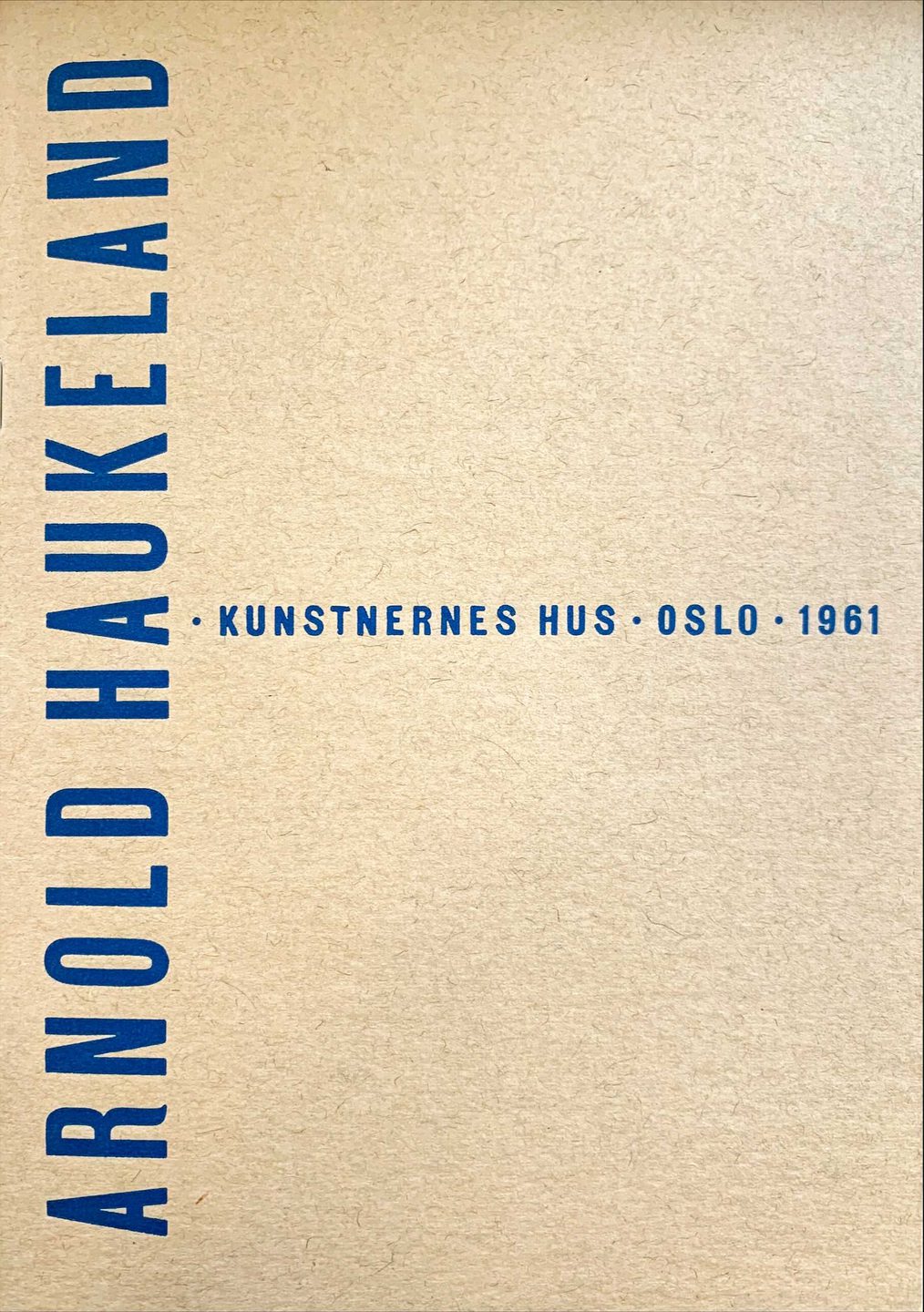
This retrospective exhibition with Arnold Haukeland was shown at Kunstnernes Hus in April 1961 and was part of a two-part exhibition together with Jakob Weidemann. In this exhibition, the public could see 34 sculptures in the techniques of plaster, bronze, iron and plastic concrete. Eight photographs of Haukeland's monumental works were also exhibited.
Extract from the catalogue
Arnold Haukeland´s statue of liberty in Bærum is his first official work. There is a general agreement that this equestrian statue is not faultless, but the question is if some of the faults do not evince alarming traces of artistic consciousness. Of course the horse has a preposterously heavy hind part and its tail far too large a curve. But if we approach from the east and see the sculpture against the town hall wall, it becomes apparent that these exaggerated forms correspond with the arches in the row of windows. And certainly the equestrian has an unreasonably long neck. But looking at the sculpture straight from the front, we see it rising powerfully above the horse's large neck.
The strong side of this sculpture is the execution itself, the hand's powerful grip of the clay, the live modelling. And this we shall meet in work after work at this exhibition. ...
... In free form figures can also be modelled, but they do not relate to the model. They are creatures seen by fantasy. And here the forms can also be a product of the meeting of powerlines. The artist, like the physicist can fable that the universe does not know the difference bes tween power and matter.
Space is the only thing which is, and we are unable to define its mystery. But when the artist creates shapes which clearly stand like products of the interplay of the powerlines, and the shapes stretch out arms from the area where the lines of power meet, — then maybe the work of art, like physics expresses someting of modern space mysteries.
About the artist
Arnold Haukeland (1920-1983) was one of Norway's most important abstract sculptors. He was educated at Det Illegale Akakdemi during the war and later studied art in Paris, Italy, France and Spain. Until 1949, Haukeland worked as a sculptor and decorated parts of Nidaros Cathedral in Trondheim, as well as creating monuments in Ålesund and Bærum.
From 1958 he switched to an abstract form of expression and initiated a debate around modern experimental sculpture. Haukeland created abstract compositions in monumental format and changed the view of sculptural art in Norway, which at the time was dominated by the traditional figurative style.
Haukeland is represented by, among others, Sonia Henies og Niels Onstads Stiftelser with several sculptures, the Oslo Municipality Art Collection and the National Museum.