Agnes Hiorth
02.03.57 – 17.03.57
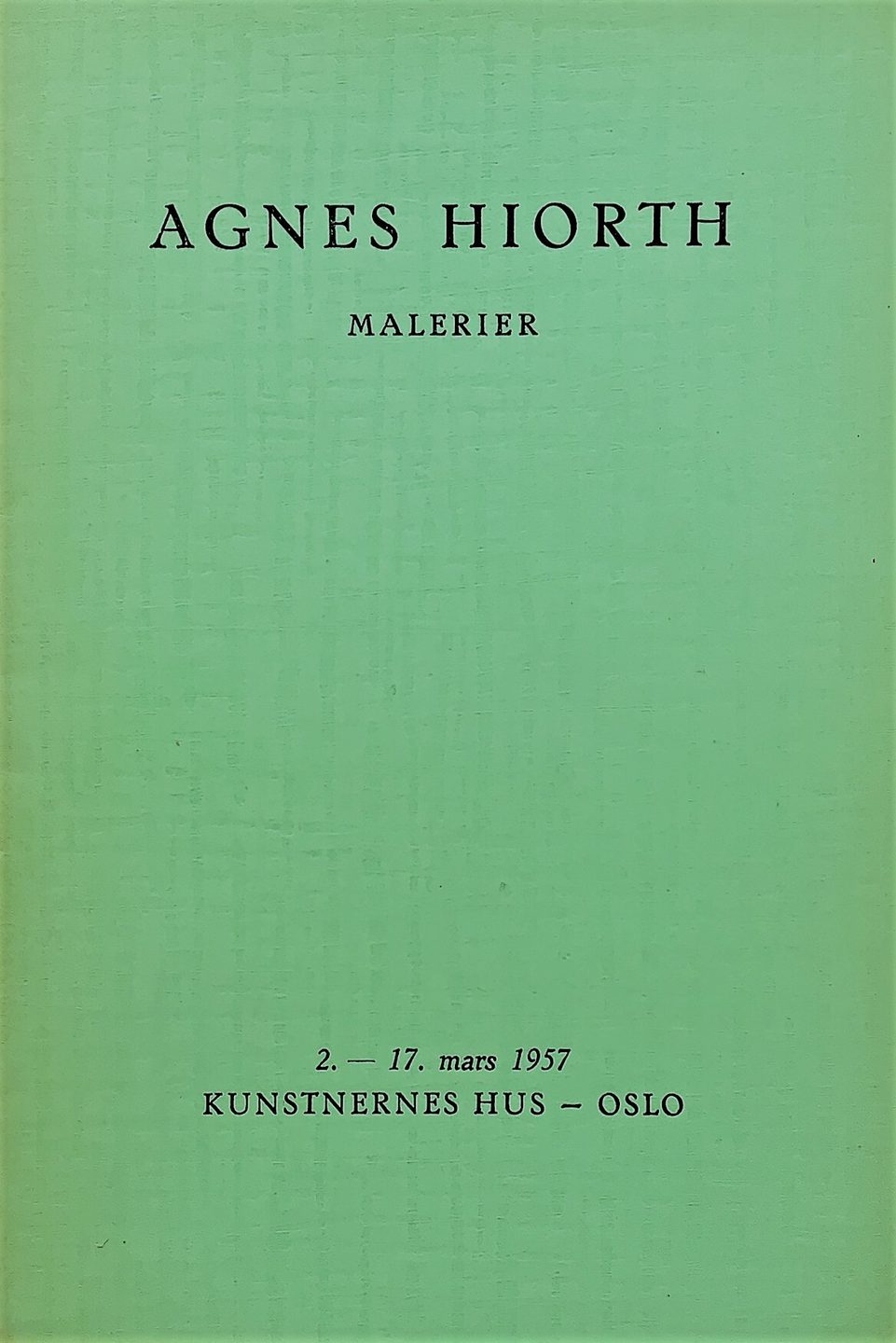
Paintings
Agnes Hiorth is known as a portrait painter in particular and painted, among other things, a number of representative portraits of the royal family.
Agnes Hiorth grew up in Kristiania. Her mother painted, and it is likely that Agnes was encouraged to draw and paint when she was growing up. At the age of 19, she began as an apprentice with the painter Harald Brun. She was then a student at Pola Gauguin's painting school 1918–20 and at the Norwegian Academy of Fine Arts for two periods, under Axel Revold 1925–26 and Georg Jacobsen 1935–36. She made her debut at the National Autumn Exhibition in 1922 with the landscape painting Vår i Bærum. Two years later, she had her first solo exhibition, and it was mostly landscapes and religious motifs that she then showed.
The two stays at the Academy of Fine Arts did not immediately translate into Agnes Hiorth's art. Neither Revold's colorful art nor Jacobsen's theoretically based painting seem to have left a particular mark. Her painting has been characterized as neo-impressionist, and the choice of colors is often muted and balanced, the brush strokes are light and the forms are at times almost dissolved.
It is particularly as portrait painter Agnes Hiorth is known. Both in the present and in the future, her portrait art is highlighted. She has painted a number of representative portraits, but also portraits of a more private nature. Among her most famous works should be mentioned the portraits of members of the royal family, King Haakon 7, Crown Prince Olav, both 1948, Crown Princess Märtha, 1957, and Prince Harald, 1950.
Agnes Hiorth has also painted a large number of artist portraits, such as Nini Roll Anker, Fartein Valen and Olav Duun. The portrait of the composer Fartein Valen can stand as an example of Agnes Hiorth's understanding and sympathetic portraiture. With soft colors and loose brushstrokes, she calls out the most striking features of the person portrayed, but without revealing them. With a unique ability to empathize, she conveys the person she has as a model, whether it is a senior doctor, a general or the neighbour's daughter. If her palette is muted, the color spectrum is large, and her ability to balance warm and cold colors, and harmonize them with the one depicted, is very good.
Agnes Hiorth was an important personality in Oslo's artistic milieu. She had good contact with other artists, and her studio was open to visitors one evening every two weeks. Young painters came here, but also writers and composers, and the topics of discussion were many. Her output was not large, and as the commissions poured in, it came to consist more and more of portraits. To some extent she also continued with landscape painting. Three of her landscapes can be found in the National Gallery. She also painted several religious compositions.
Agnes Hiorth is represented in, among others, the National Gallery, Bergen Art Museum, Lillehammer Art Museum and Oslo municipality's art collections.