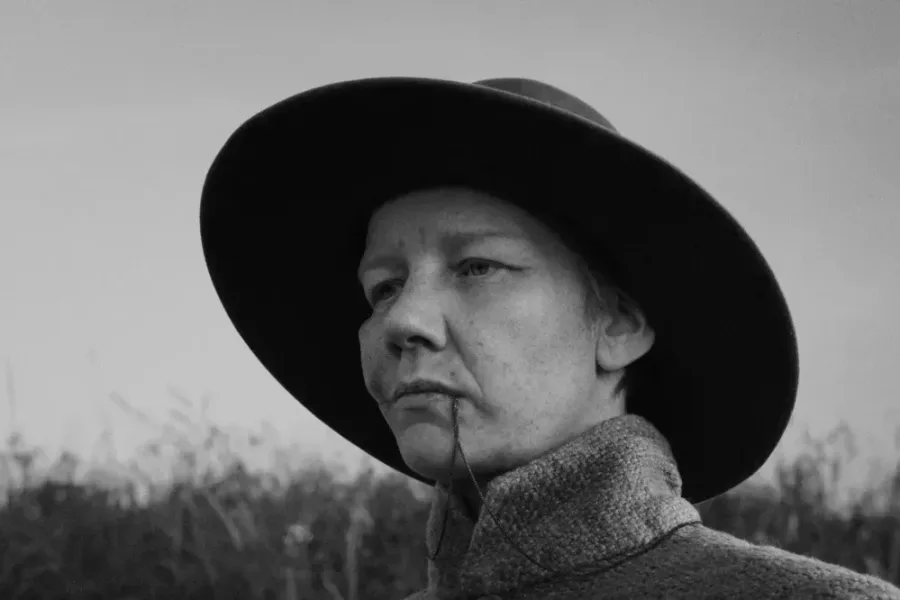
Wipe Out
Film premiere, sound piece and conversation with Maja S. K. Ratkje and Signe K. Emmeluth
Wednesday 22.04.26
Wednesday 22.04.26

Welcome to the premiere of the acclaimed contemporary composer Maja S. K. Ratkje’s first film!
The film’s title, Wipe Out, refers to erasing someone or being completely worn out. The film’s performer is saxophonist Signe K. Emmeluth, who has made a name for herself in the international free jazz scene and whose project is to push herself and her instrument toward physical extremes. The film is presented together with the sound work 1100 Screams, a noise piece played in darkness in the cinema after the film.
Between the film and the sound piece there will be a conversation between Maja S. K. Ratkje and Signe K. Emmeluth, led by Guri Glans. After the program in the cinema, there will be a concert at Kunstnernes Jur (the restaurant) with Signe K. Emmeluth, Magnus Nergaard and Dag Erik Knedal Andersen.
About the program
18:00 Film screening: Wipe Out (28 min)
18.30 Conversation between Maja S.K. Ratkje and Signe K. Emmeluth, led by Guri Glans
18.45 Sound piece: 1100 Screams (11 min)
Maja S. K. Ratkje on Wipe Out (spoiler alert!)
The main idea for the film, which I have carried with me since the early 2000s, is to bring out the spaces between a solo saxophonist’s wild outbursts with the instrument. I have attended an great number of free jazz concerts with solo instrumentalists who pour all their energy into their instruments, and the saxophone is perhaps the loudest, most typical, symbolic, and physical outlet of them all. You imagine a rather macho performer, sweating and bracing themselves for each piercing phrase, breathing and panting in the gaps, completely absorbed and focused on the role. It is a fantastic field of energy to be in.
So I thought: what if you remove what is supposedly the goal of all this—the actual sound of the instrument? I envisioned a film installation where everything that is the blowing into the instrument is cut away, leaving only what happens in between: exhalations, fiddling, keywork, panting, and renewed attempts. What remains then? The sound of the free jazz saxophone is already a cultural imprint within us, as iconic as it is.
I had a particular saxophonist in mind for quite a long time, but never realized the idea. Then a new acquaintance appeared: a young Danish-Norwegian saxophonist, Signe K. Emmeluth. We made a recording of Signe in a studio with focused lighting on her face and instrument. It was a trust-based situation, where the task was to play—and play as intensely and virtuously as possible—until she could go no further.
The work draws inspiration, among other things, from the poem Run Ragged by A. R. Ammons. “Run ragged” is an English expression meaning “to be completely worn out.” I wanted to explore what this means through a work for a musician with a powerful voice on her instrument, but who is subjected to censorship. What remains of an expression when the strongest statements are erased? Is there power in the spaces in between? Before inhalation and exhalation? Will something else emerge?
The film was recorded at Børsen Kulturhus in Tangen on June 18, with Håvard Skaset as sound engineer and Sigurd Ytre-Arne behind the camera.
About the sound work 1100 Screams
The work is intended to complement the film Wipe Out. It is a surround noise piece to be played in darkness in the cinema after the film, containing 1,100 unique screams that were edited out of the film.
About Maja S. K. Ratkje and Signe K. Emmeluth
Maja S. K. Ratkje is a composer, performer, and improvisational musician. Her music has been performed by leading orchestras and ensembles around the world. Ratkje has collaborated with performers such as Ensemble Modern, Ensemble Intercontemporain, Klangforum Wien, BBC Scottish Symphony Orchestra, and Red Note Ensemble, and has herself performed with POING, SPUNK and Avant Joik.
Signe K. Emmeluth is a Danish saxophone player, composer and improviser currently based in Oslo. Her music explores the relationsship between fixed and fluid components, and she is interested in the intersection between composition and improvisation and the flexibility in this space. With a sharp and unique tone her playing is easily recognized. Melodies with rapidly changing octaves and a shift between the naive and playful to brutal primal screams are some of what makes up Signe Emmeluth’s vocabulary.
Photo
Title
Wipe Out
Directed by
Maja S. K. Ratkje
Country
Norway
Year
2026
Languages
None
Duration
28 min