The Director's Annual Summary
Kunstnernes Hus' director Sarah Lookofsky looks back on the year 2025.
Published
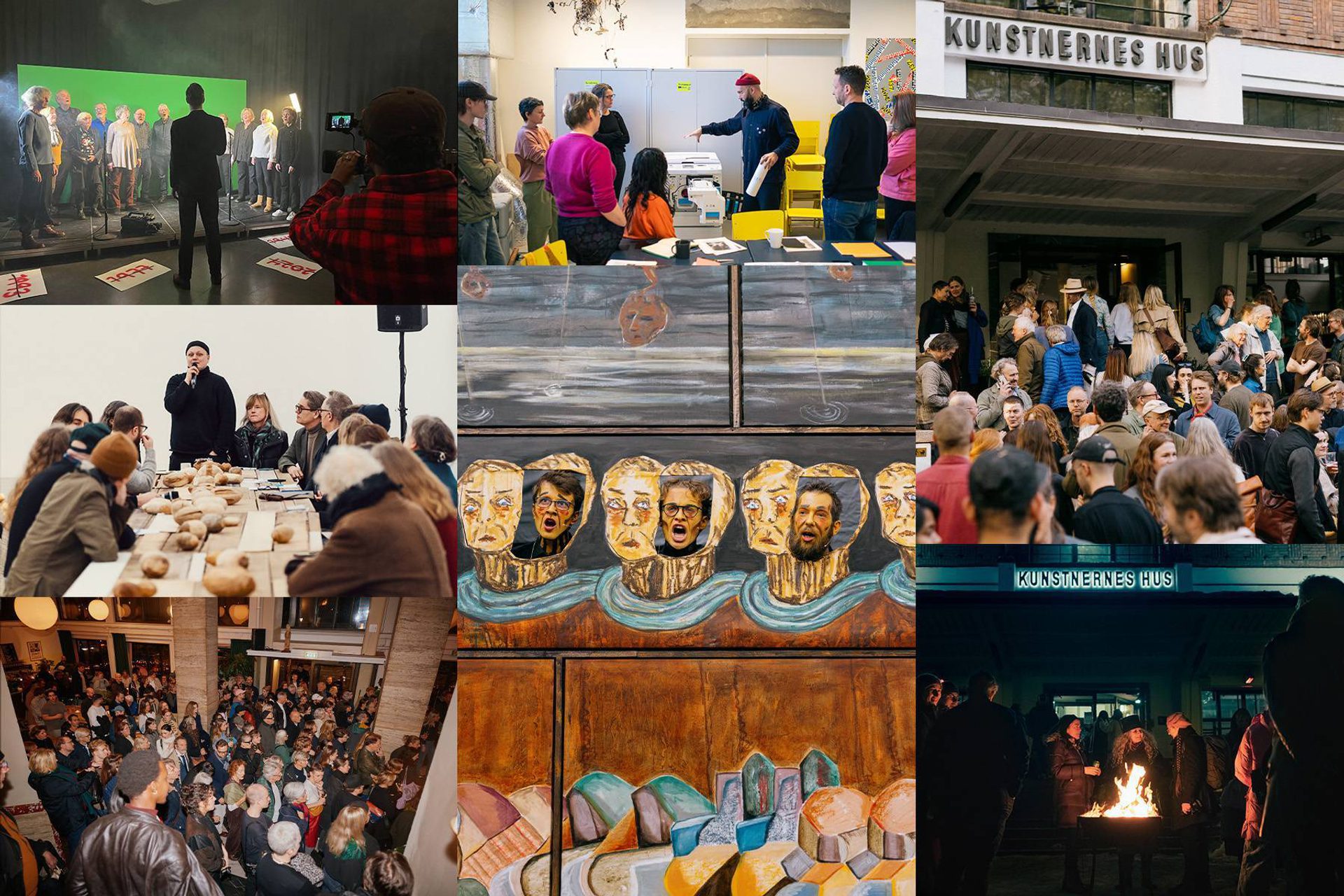
What stands out from 2025 are the many moments of gathering that unfolded in the house. After a procession of trees carried into the building—first by the artist and then by volunteers in December 2024—Jannik Abel’s Back to the Land became a space for both contemplation and conversation. The accompanying series Back to the Table hosted critical discussions on the role and responsibilities of art and institutions in times of crisis. On the façade, banners by Andrea Geyer declared: “Jeg vil ha et museum som kjenner sine gulv skjelve når andre museer ødelegges i krig” and “I need a museum where I can find more than myself,” articulating a vision of an institution grounded in relation.
Several exhibitions engaged contemporary political realities. Joen Vedel created a broadcast exhibition using a televisual methodology that merged event and representation. Sudanese cartoonist Khalid Albaih’s Refresh threaded through the house and was continuously updated to reflect current events. Tuda Muda’s BLINK addressed violence against women, transforming the artwork into a revenge fantasy. Eszter Salamon presented Mothers and Daughters, a choreography composed and performed by a mother–daughter pair in each skylit hall for full-house audiences. This doubling continued in Steinar Haga Kristensen's two “identical” exhibitions, finally fulfilling a long-standing spatial invitation of the building’s twin halls.
The MFA exhibition by graduates from the Academy of Fine Art this year also engaged the building itself, winding through the entire ground floor and into rooms rarely used for exhibitions. The final exhibitions of the year highlighted the building’s 95th anniversary. Together with Høstutstillingen (organized by the Association of Norwegian Visual Artists) and its artist jury—who reached a record audience of over 31,000 in just five weeks—we hosted a birthday celebration and fundraiser with a full performance program and a signature cocktail.
Exploring the many stories embedded in the building, Helle Siljeholm and Ingri Fiksdal created a choreographic installation that summoned the ghosts of art production—from criticism and cultural policy to the rejection letters of artists seeking exhibitions here. In parallel, Stian Ådlandsvik evoked both the Nazi occupation of Kunstnernes Hus and the companies that went bankrupt in 2025, assembling objects from their ruins into sculptural towers.
Throughout the fall, students and professors from the architecture school researched the material provenance of the building—from pipes and vitrines to radiators and layers of paint. Their findings resulted in an exhibition in Hvilerommet, the small upstairs room overlooking Queen’s Park. These insights will be invaluable for the forthcoming rehabilitation project.
In 2025, we advanced our fundraising efforts, securing NOK 7.5 million—the maximum award—through Oslo Kommunes Kulturhus scheme. Although we did not receive state funding in the 2026 budget, the artist community has offered extensive support through donations and public statements, contributing to political and media attention. We still aim to begin rehabilitation no later than early 2027. You can follow along with our fundraising progress and contribute here:https://husetvart.kunstnerneshus.no/
A guiding principle throughout has been the 1928 competition program won by Blakstad and Munthe-Kaas: to create a clubhouse for artists. We are still guided by this ambition and spirit. We have lowered our membership prices, and extended its offerings, to invite people to return again and again. Since summer 2025, our partnership with Kunstnernes Jur has further animated this spirit through music, events, and excellent, affordable food and drink.
A recurring theme this year has been relationality—characters doubled, mothers and daughters, structures of support in times of crisis. This continues next year with an exhibition titled Support Structures, reflecting how artists, like all people, depend on others for production, inspiration, and existence. Likewise, the house is more than a building; it is a container for relationships past, present, and future.
In January 2026, the Office for Contemporary Art will move into the back of the building to develop a residency program. Their presence will bring new ideas and collaborations. We are grateful for the time you spent at Kunstnernes Hus this year and look forward to welcoming you back in 2026. Happy New Year.