Richard Deacon
20.01.90 – 18.02.90
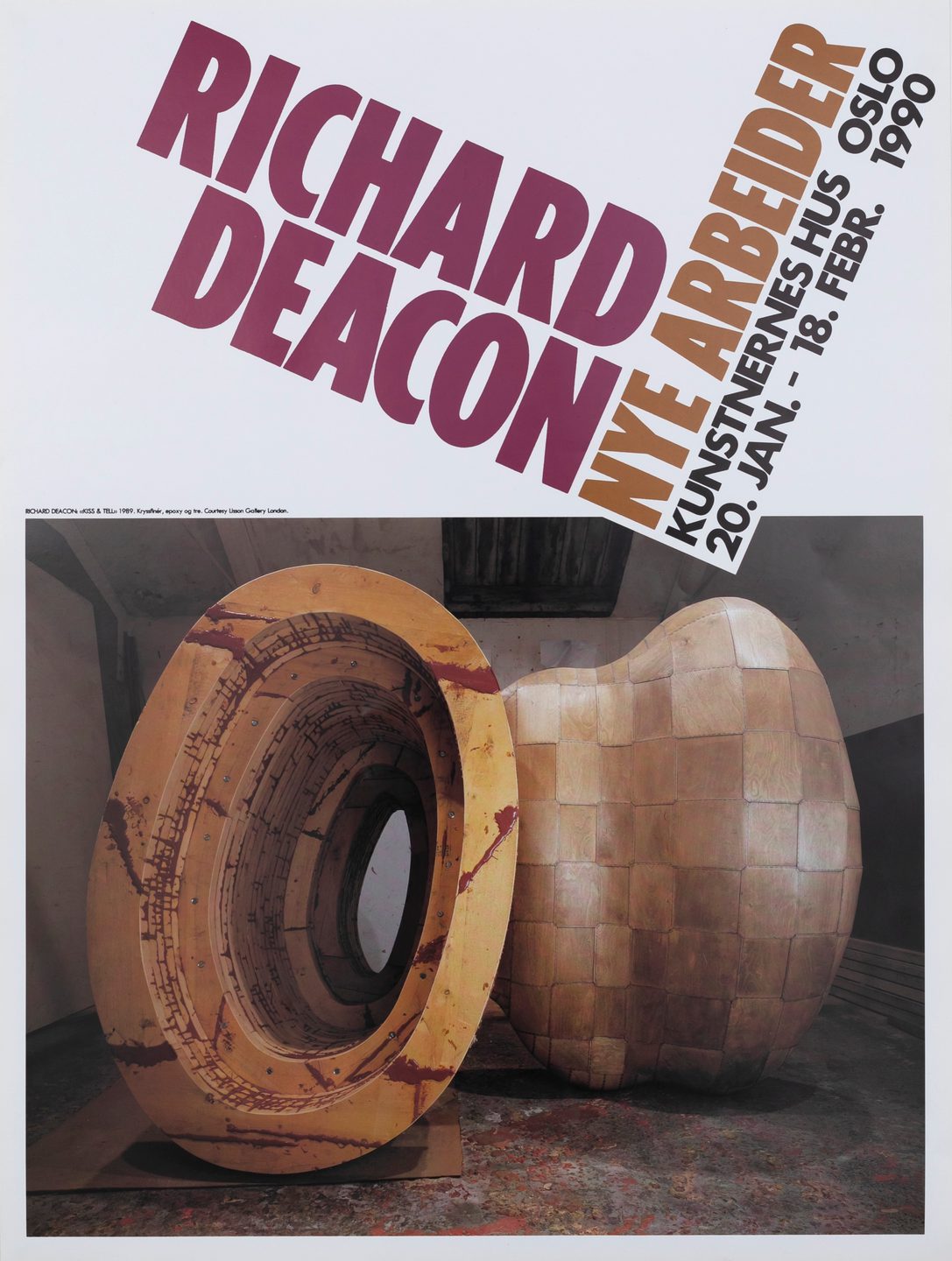
Richard Deacon - New works
On the exhibition
The exhibition and its accompanying artist's book explored themes of geographical and structural interconnection, with laminated wood as a central material, amongst others. Deacon's practice tends to revolve around complex, organic sculptures, often on a large scale, in which the construction process itself and the properties of the material are as significant as the finished work.
From the artist book
“Moulins Cherier, France – 17.8.86
Dear Rebecca,
It’s as if there is a gap between intention and action, as if each time I commence, the clarity of the intention evaporates and I am left doodling and scratching around. I have been trying to make a book which I want to call Gondwanaland and which tries to parallel or model or represent what I find compelling in that paleogeological concept. The existence of these places (the primal continents) is a deduction, an extrapolation backwards from the facts, from the evidence in here and now. We are accustomed to the idea that the conditions of life have changed, both materially and biologically, and even that the contours of the earth alter – mountains rise and fall, deserts move. But the notion that it could be a different place, that instead of Europe, America, Africa, Asia, it was somewhere else, is both fantastic and compelling.
As a boy, always aware both of the possibility of imminent cataclysmic disaster and of the desire to leave, I used to keep ready to hand under the bed a small case. Amongst the things it contained – false documents, money, food, whistle, knife, string etc – was a map. It was a map I had drawn. The map had no relation to where I was, self evidently I knew where I was but would be going somewhere else, to a place I did not know. In such place a map is useful. The map as I remember had a shape – as if it were the map of an Island – with a few notional geographical features. Shape is the outside edge, boundary, extremity, limit. It is other. By contrast a street plan for example has no shape separate from the sheet on which it is printed. There is an implied continuity between the map and the place which one stands. Somehow therefore, in order for my map to represent another place in the intended sense there was a necessity for it to have a shape or boundary. The contour of the interior, however, is always more difficult.
Regards to Martin,
Love,
Richard”
Richard Deacon Atlas
On the artist
Richard Deacon (b. 1949, Wales) is a British visual artist and sculptor. Sweeping, organic forms are realised through his traditional craft and workshop practice, with welding, pressure-formed and laminated wood and riveted metal being repeated throughout his work. The works read as a kind of poetic meditation on a tradition of craft industry that was once widespread in Britain, but has largely been displaced by high-technology production.