ANTENNE ANTENNE
MFA Degree Show 2026
05.06.26 – 02.08.26
05.06.26 – 02.08.26
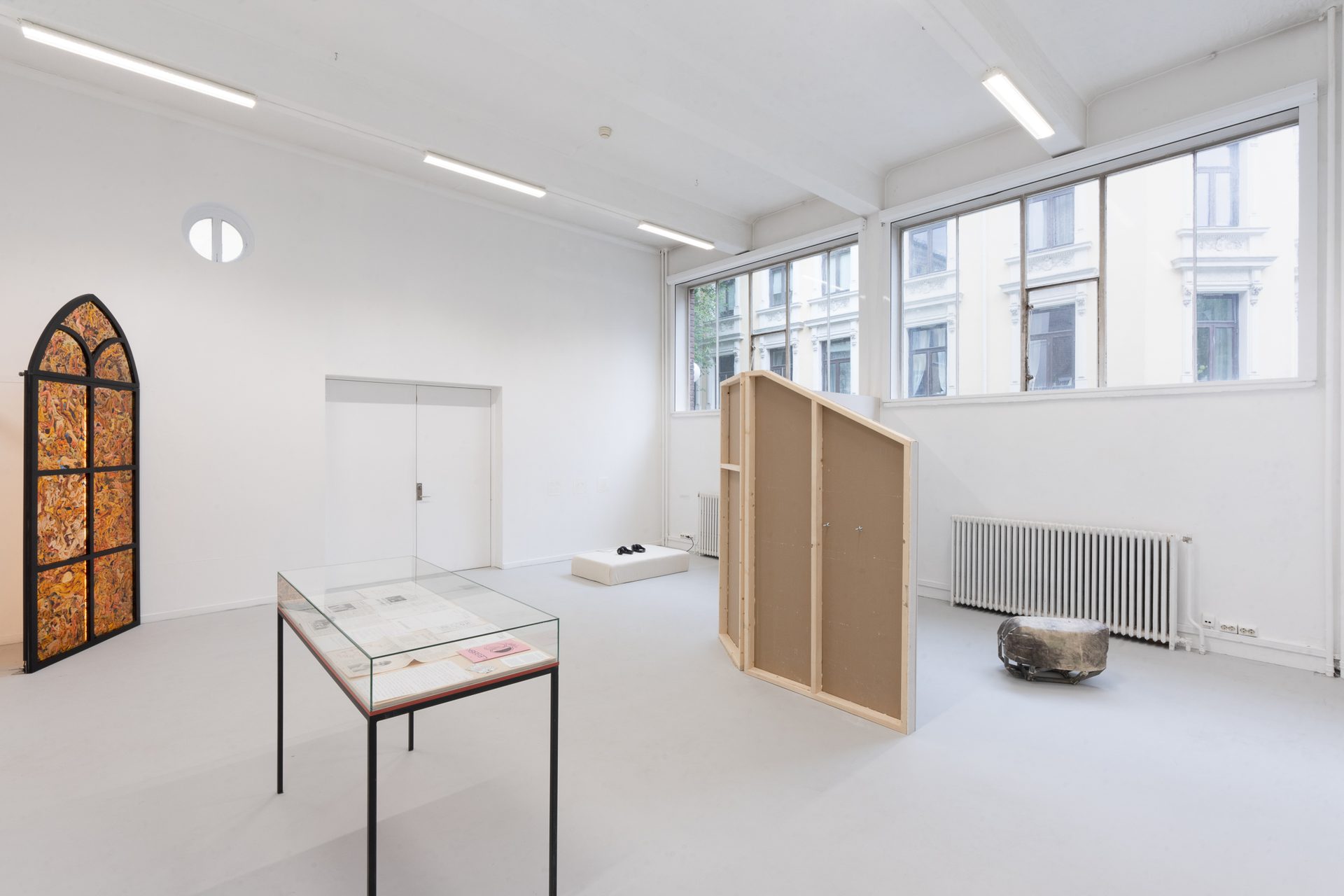
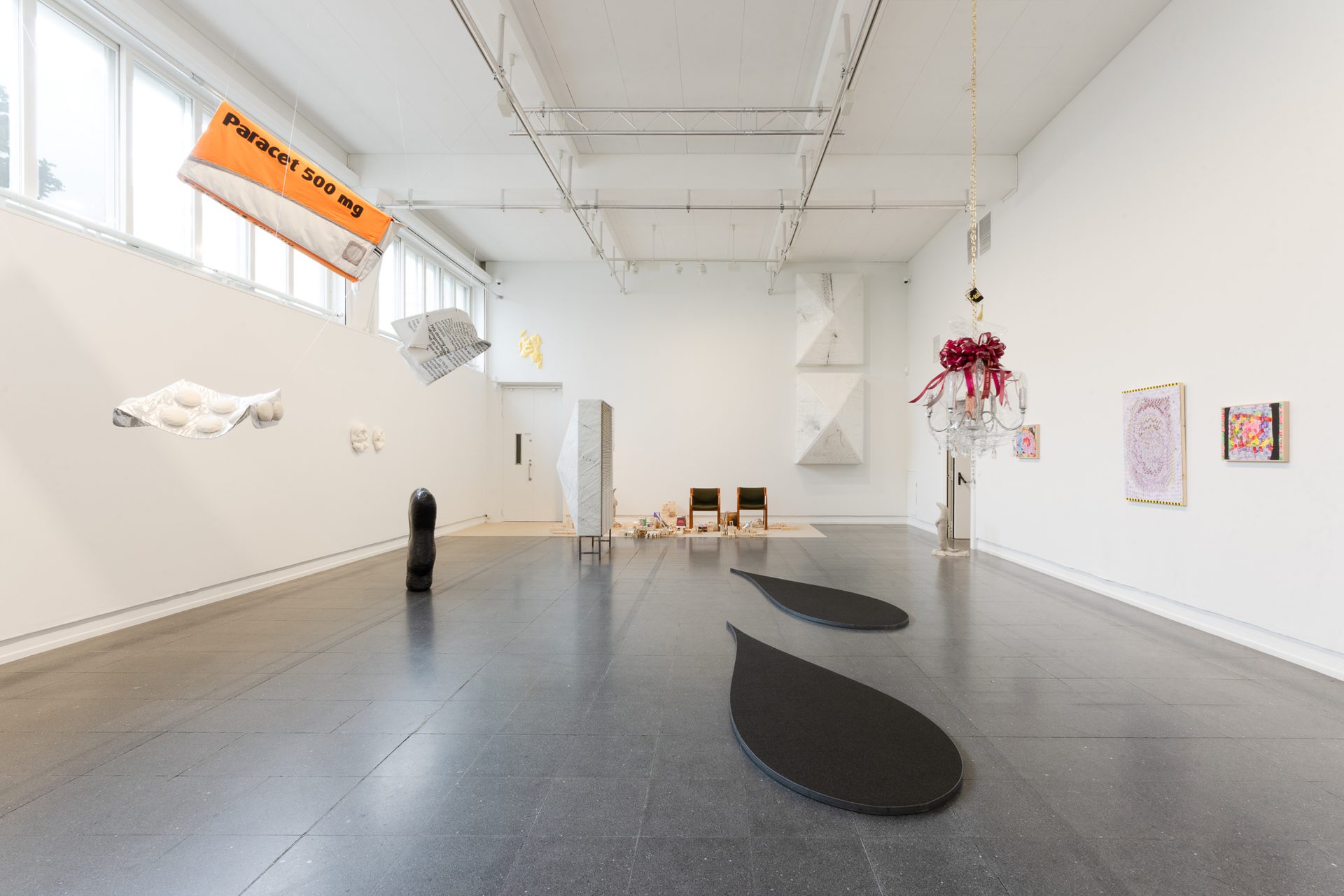
The master's students at the Academy of Fine Art, Oslo National Academy of the Arts, present their work in a joint degree exhibition at Kunstnernes Hus. The exhibition is a conjunction of collective efforts through a radio show, a library, a self assembling publication station, a cabaret and performance programme orbited by individual contributions in the various spaces of Kunstnernes Hus.
A reason to reach out to people, to make it together and make it to share. Self-organize, without necessarily agreeing. Transmitting, making an infrastructure for relational effort.
About the Exhibition
The title “Antenne Antenne” is Norwegian for both “antenna” and “spark/ignite”, giving flight to ideas of listening in, receiving a multitude of signals, and at the same time spark something; resistance, a provocation, an energetic field, a leak, a laugh. In the case of the master´s degree exhibition, it might spark or activate beginnings, ongoings and endings by self-organized effort, engaging in formats which by definition offers the group an invitation to listen in and reach out.
The collective spark invited the format of the radio station and listening space, the library, the stage, and the interactive assembly of material into publication as the core, collaborative elements of the exhibition.
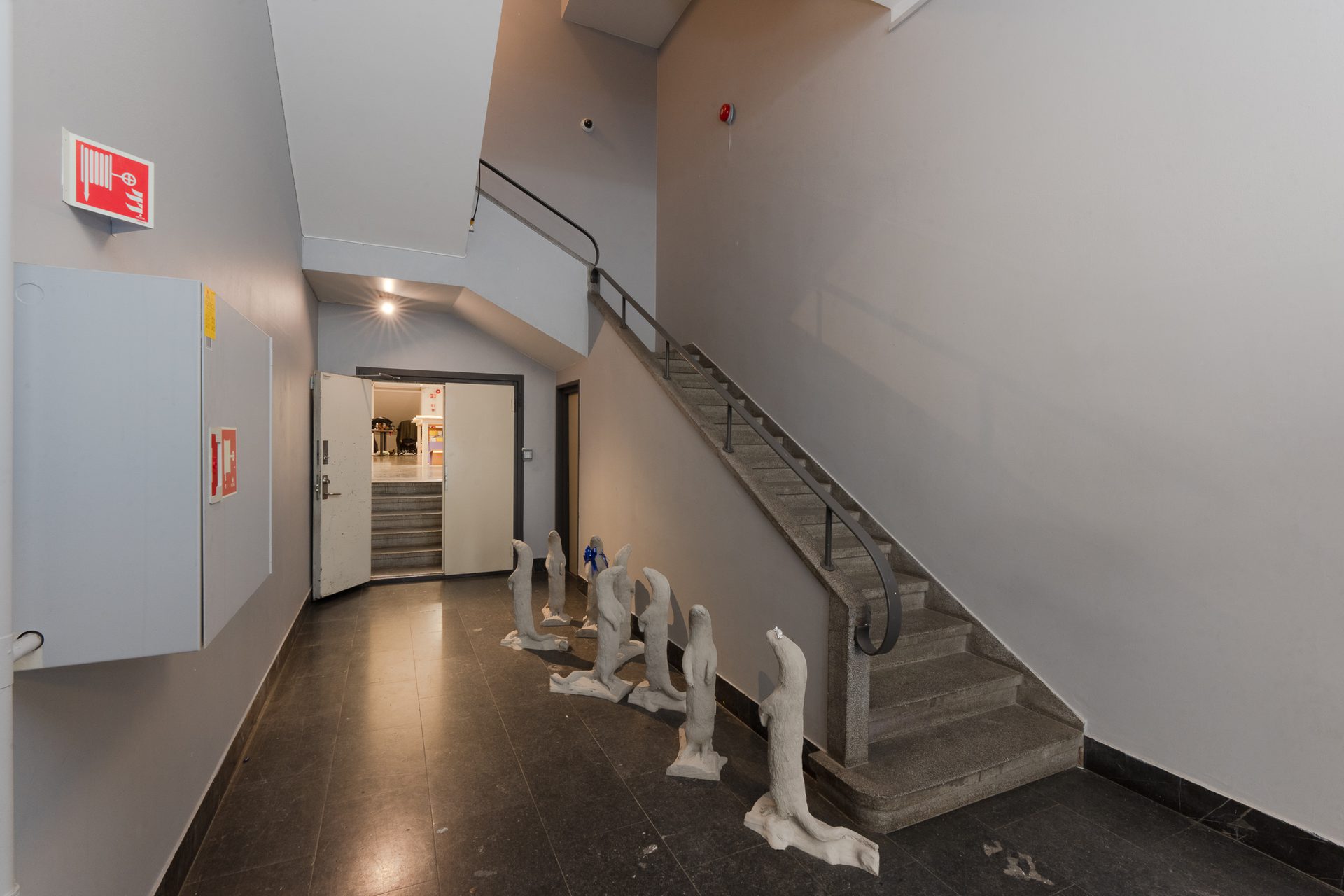
The sculptural presence and performative nature of the cabaret-inspired stage extends into both the restaurant and the exhibition space. A flock of sculptural otters - reproductions of the café’s own - guide the audience through elements of the artist's individual practices, sometimes in fragments, sometimes dialogue with the house, sometimes as entire works of art. These reside within and around the collective structures, in the spaces between them, and throughout the large exhibition hall on the lower floor of Kunstnernes Hus.
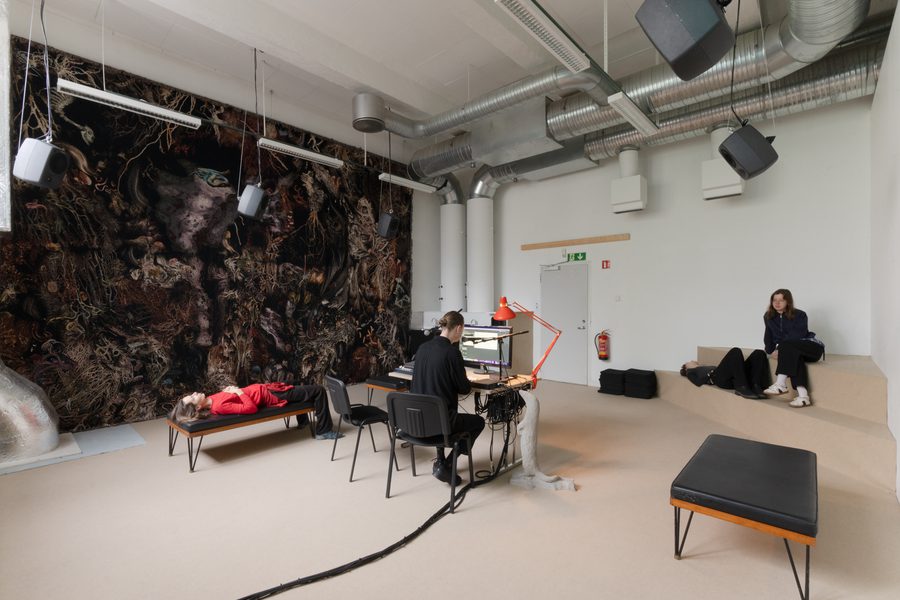
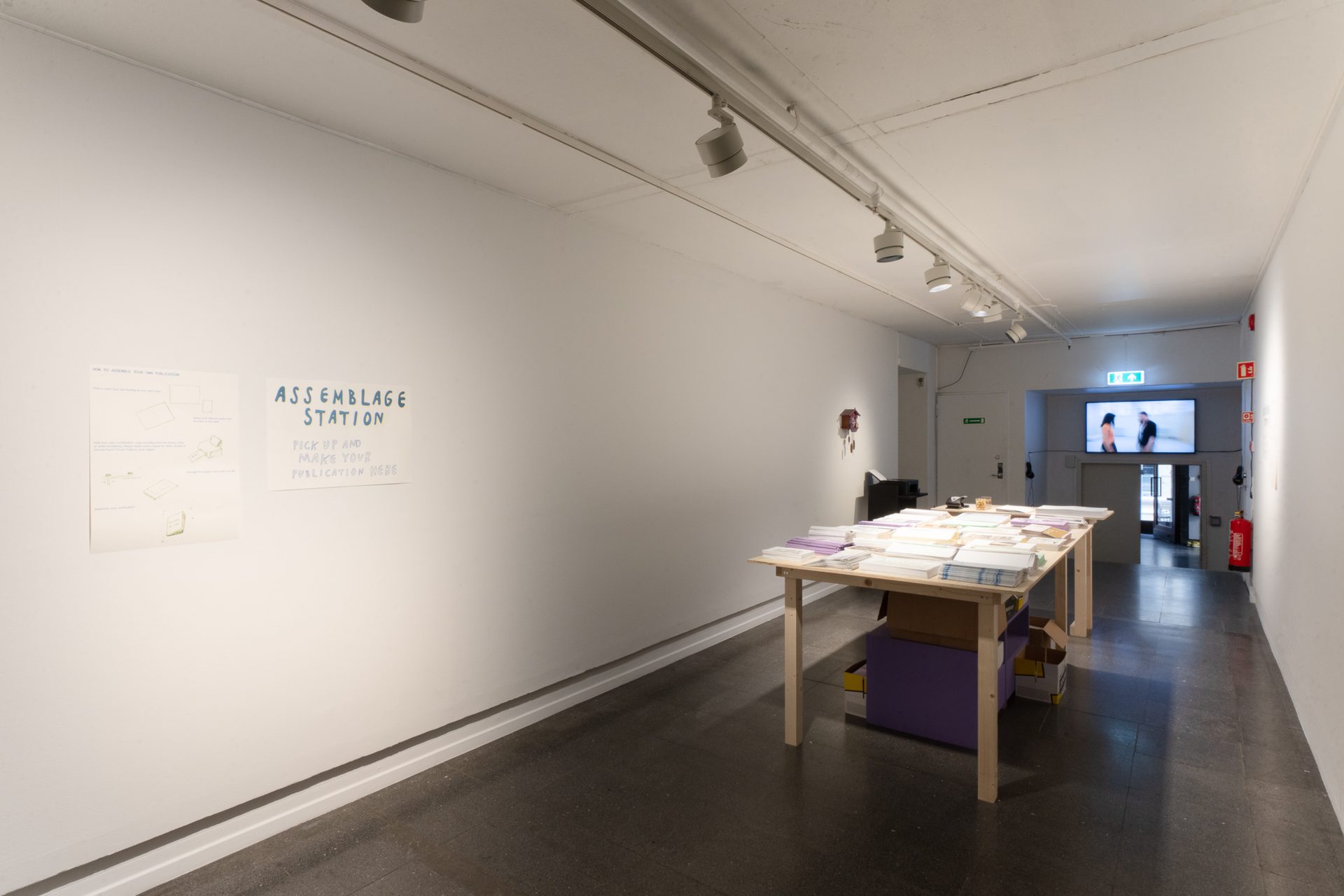
Pakkerommet hosts the radio- and listening station, the stage commutes between the restaurant and the exhibition space, both hosting programmed events throughout the exhibition period. Located in the corridor there is a self-assembling publication station. Here, visitors can compile their own edition of the publication, consisting of a fixed cover filled with materials that change in response to the exhibition's evolving programme.
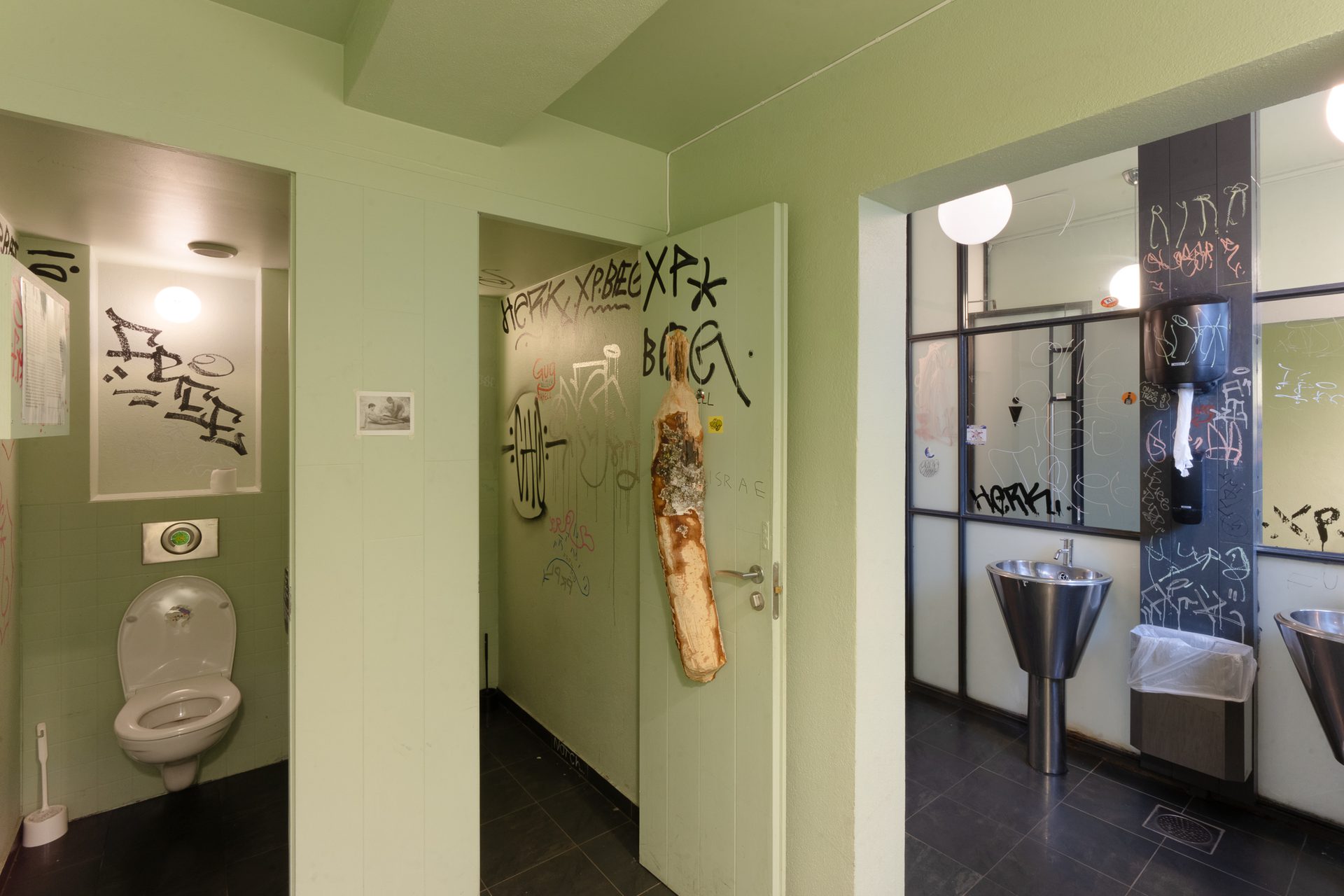
The exhibition extends across the café and terrace, the reception area, the lower gallery, the Academy Room, the basement toilets, Pakkerommet, and the corridors.
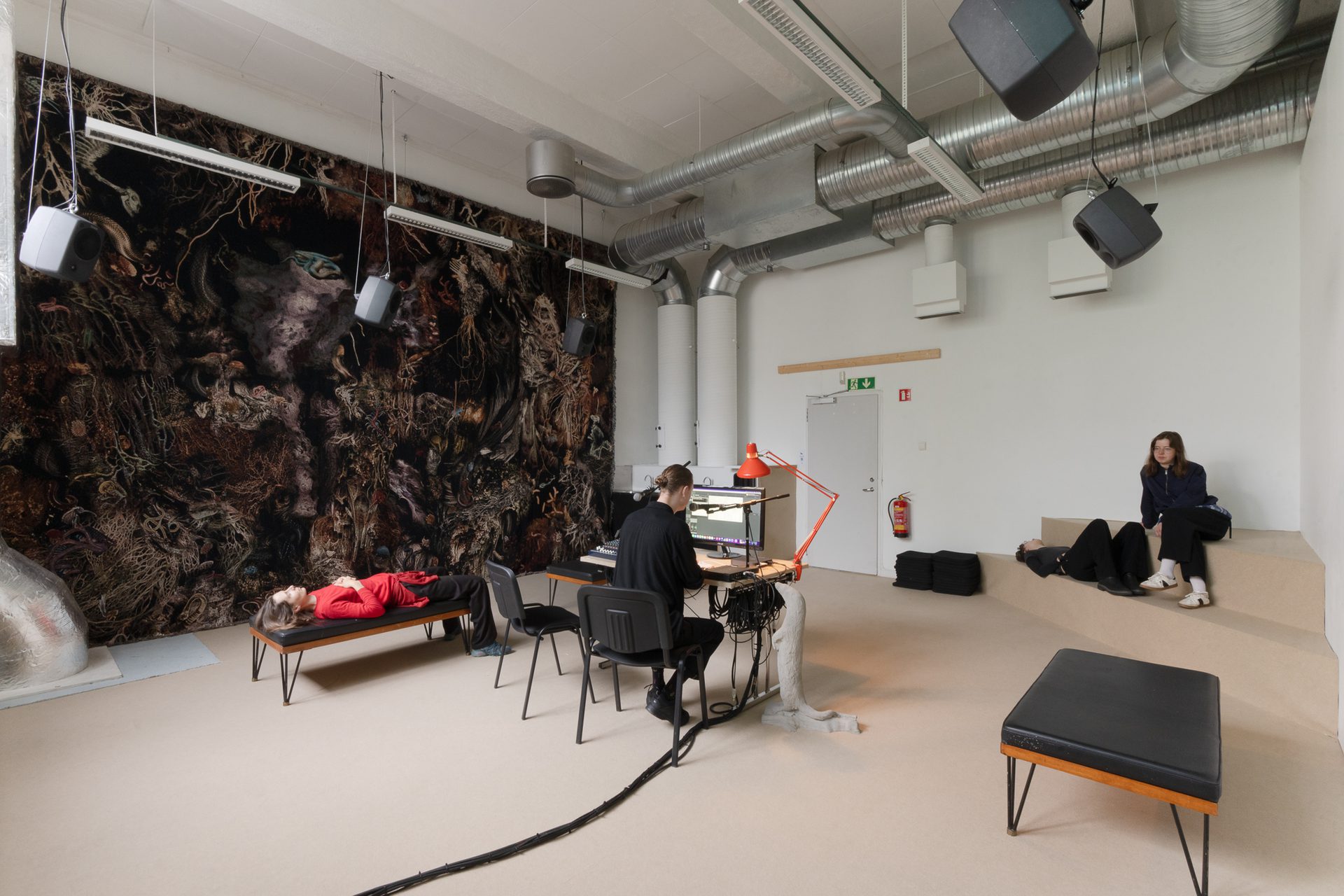
Photo: Jacky Jaan-Yuan Kuo 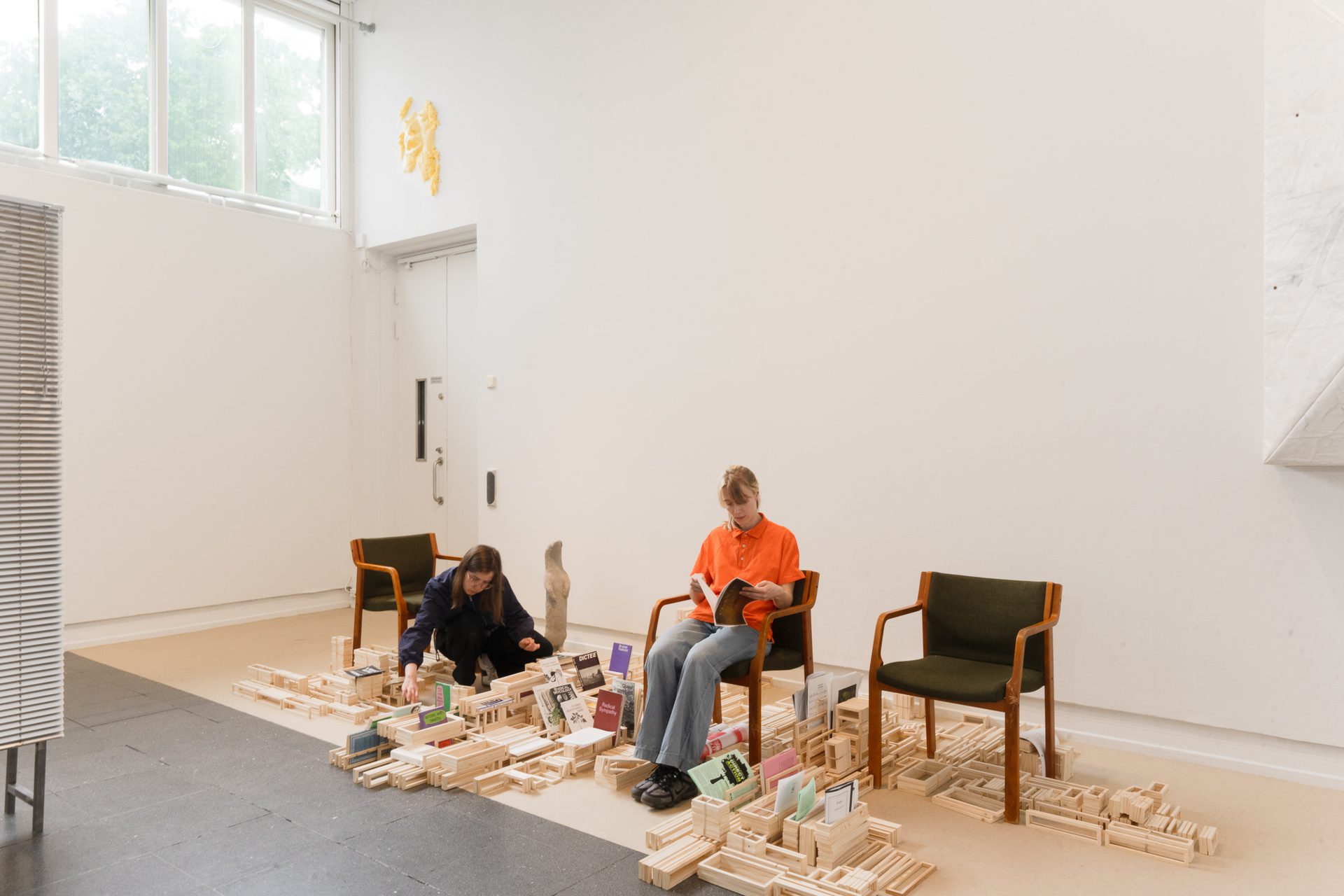
Exhibition Groups
Architecture
"The architecture group took on the task of trying to trace the ever-evolving ideas and visions that appeared during the process of this group exhibition. To approach the architecture both as a physical structure and as a fiction, we built a 1:25 scale model of Kunstnernes Hus. Within this framework, we worked with two existing elements from the building. The wall-to-wall carpet from Shuruq Harb’s previous exhibition Interrupted Futures in the lower exhibition hall and the otter positioned above the entrance. These elements were reworked into architectural gestures and narrative devices within the exhibition.
The decision to preserve Harb’s sand-coloured carpet allowed the Palestinian landscape it reflects to remain as an underlying presence throughout the exhibition, while also pointing to the ongoing realities that continue to shape our attention. Alongside this, we reworked the otter, a taxidermied figure standing above the building’s entrance and exit. Through duplication and reinterpretation by all the participating artists, it became both a physical trace of our collective process and an extension of our exit out of Kunstnernes Hus itself.
Throughout the process, we discussed institutional frameworks, the limitations of the group exhibition format, and the particular charm of the chaos we have created together. We did not necessarily succeed in maintaining a complete overview, but perhaps such an overview was never truly possible, nor even desirable to insist upon."
Food & Entertainment
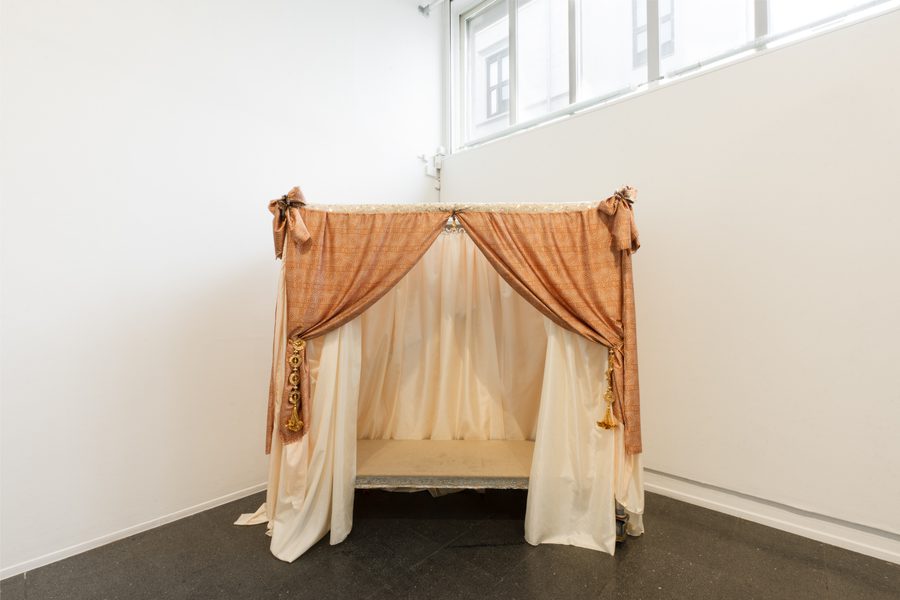
"Kunstnernes Hus has, like every proper house, a pulsating rhythm brought by the heart that is a kitchen. The museum foyer is not only a transitional space. It's a place for conversation, flavours and smells. The waiting personnel pace back and forth, candles flickering on tables, as the patrons gets served with sophisticated dishes. But there is nothing like a dinner accompanied by a show. Apart from the usual museum guests, we realised there was a whole potential audience in the restaurant. What if an experience could be brought to them, as they sat there, already with their senses primed, but unsuspecting. With a streak of cabaret culture and a nod to nighttime entertainment programs at all-inclusive resorts, the Food & Entertainment group will bring performance, movement, sound and audience interaction into the mix of this exhibition program in an unexpected, constantly evolving way. Follow the trails of the draped stage on wheels as it changes and unfolds its shape, moving from one space to another, expanding the concept of both exhibition and restaurant."
Library & Publication
"The dialogue within our group emerged from discussions exploring how collaboration can take different forms, and how we can enter this process in our attempt to find a collective persona. Speculative questions around collectiveness, what a future of togetherness would look like, and a temporary utopia became a point of entry. Alongside a strong interest in the place of the individual within a shared process, this became the second entry. Rather than viewing individuality as something that creates friction, our different voices became a metaphor for collectivity. The hidden material which intervenes and weaves a narrative in our day-to-day practice is revealed.
An ‘assemblage station’ is an area where the audience can assemble and make their own publication using an open-close binding system. Interactive printing and scanning opens up opportunities for ongoing contributions. It moves between the idea of a ‘living publication’, a ‘patchwork’, or perhaps a ‘surface’ that evolves alongside the exhibition. The stations within each exhibition space, placed amongst artwork and performative contributions, move toward becoming traces and murmurs throughout the spaces."
Radio
Radio Antenne is a temporary community radio hosted by graduating students as part of the exhibition ANTENNE ANTENNE at Kunstnernes Hus. Across several Saturdays and Sundays in June, you are invited to join us at Pakkerommet for five live radio broadcasts. Radio Antenne tunes outward - towards peers, communities, places, and urgencies. Through different frequencies of attention, we move through sound works, archival material, conversations, readings, and music. Moving between transmission and reception, the radio becomes a space for resonance, exchange, and collective listening. Each episode brings together contributions from students in the MFA programme alongside external artists, knowledge keepers, activists, sound nerds, and thinkers we look up to. The radio group consists of Catriona Beckett, Manos Saklas, Anders Hagen, Franciska Seifert Eliassen, and Anna Näumann. Broadcast times and dates are available in the exhibition’s public programme. Previous episodes can also be heard in the space throughout the exhibition period.
Artists and List of Works
Camilla Bahnsen
Camilla Bahnsen is a Danish multidisciplinary artist based in Copenhagen and Oslo who works with themes surrounding feminine and queer identity, occultism, lost youth and liberation from patriarchal power structures. Drawing on the shadow and the history of witches and female labour, she creates ambient, destabilising and symbolically charged environments, avatars and amulets that are characterised by a sense of curiosity, protection and resistance. Her latest research investigates the relationship between childhood imagery, capitalism and desire. She holds an MAA from the Art and Architecture Program at the Royal Danish Academy in Copenhagen (2017) and more recently, she earned a BFA from the Bergen Academy of Art and Design (2024). She will be exhibiting at this year’s Høstutstillingen 2026 in Oslo arranged by Norske Billedkunstnere (NBK).
Works in the exhibition:
Stone Tears, 2026, Camilla Bahnsen
Sculptural installation. Welded steel metal frames, black aluminium silicate. 6m x 3m.
This sculptural work curiously examines the state of grief fatigue in a world marked by genocide, rising chaos and catastrophes.
Hole, 2026, Camilla Bahnsen
Ceramic sculpture. Glazed stoneware. 102 cm x 81 cm x 35 cm.
The sculpture is inspired by the history of witches and capitalism’s exploitation of female labour. Manifested as a space holder of glowing darkness, the mystical body both grounds and exerts resistance by means of the shadow and the unknown void.
Julie Barfod
Julie Barfod is based in Oslo, where she is completing her MFA at the Academy of Fine Art. She previously trained as an architect (MA, Bergen School of Architecture). She often works collaboratively, primarily with performance, immersive installations, text, and sound. Her recent work explores the material and social dimensions of reproductive labor, drawing connections between the private, the erotic, the political, and the cosmic.
Work in the exhibition:
Heatwaves of the Sonic Pyre: The Flaming Mouths of Saint Margarine, 2026, Julie Barfod
The work consists of three sculptural elements in margarine, a performance series, and a pamphlet. A face, two legs, and a large candle are cut-off and reassembled fragments of Feeding Furies (2026), a sculpture made from 125 kg of margarine. They accompany performances centred on the voice of a mythical two-mouthed character, presented at The Stage in the restaurant of Kunstnernes Hus. The pamphlet is distributed throughout the exhibition.
Catriona Grace Beckett
Catriona Beckett from Glasgow, Scotland, works at the intersection of two modes of creativity: process based image making and performative event making. She creates paintings, drawings, and collages that explore form through deliberate simplicity and automatic gesture. Surface, colour, and medium act as agents within the work. Her performance practice serves as a speculative lens on painting and its critical discourse, extending thematic concerns into surreal, informative narratives.
She is currently attending the MFA program in Fine Arts at the Academy of Fine Art, Oslo National Academy of the Arts and holds a BFA in Art and Philosophy from Duncan of Jordanstone College of Art and Design.
Work in the exhibition:
Declare, 2026, Catriona Grace Beckett
51 cm x 41 cm x 4 cm
Encaustic stretched on paper. Pine frame.
Pieces, 2026, Catriona Grace Beckett
71 cm X 101 cm x 4 cm
Collaged photo, gouache, encaustic and gloss. Stretched on paper.
Viv, 2026, Catriona Grace Beckett
51 cm x 41 cm x 4 cm
Encaustic stretched on paper. Pine frame.
Joanna Helen P. Blanckaert
Joanna Blanckaert is a Belgian artist living in Oslo. She expands her practice through deconstruction, repetition, and measurement, evolving from painting into installation and text. Slowness becomes a process; her hands a metronome. What was once a painted image can become a structure, a material, or, on another scale, a sentence or a word.
Work in the exhibition:
Blindrammer, 2026, Joanna Blanckaert
Site specific installation; wooden frames, 23,5 x 11 cm, 23,5 x 5 cm, and 11 x 5 cm; municipal chairs, carpet from Shuruq Harb’s exhibition.
An accumulation of wooden structures occupies the floor. The structures derive from the dimensions of the bricks used by the Béguinages / Begijnhof women communities in the Low Countries in Belgium.
Arranged in a running bond, and stacked above, beside, and across one another, they become a structure that hosts the ”library”. It contains a collection of publications, books, scripts, essays and zines from various voices in the class. Audience is invited to sit with the material and read through what captures their attention.
Blindrammer, in Norwegian, a system of blind frames.
Zida Bruun
Zida Bruun works with sculpture and installation, continually looking into materialities that serve as records of human behavior. Often by overinterpreting found objects and mimicking everyday structures, her work revolves around the unstable relationship between the self and the objects that surround it.
Work in the exhibition:
Through the understanding of otters, 2026, Zida Bruun & Lukas Moland
18 concrete casts of the stuffed otter standing above the entrance to Kunstneres Hus
The Scandinavian otter is a shy animal.
And it turns out that it has unwillingly become a container for our forever chemicals. As a result of being at the top of the food chain, it sometimes ends up in the laboratory as a measure of those of our sins that circulates through the ocean and gradually accumulate in its body over time.
We realize that we do not know what this otter is stuffed with. What we have dealt with is the shell of an animal whose body lives an afterlife that exists beyond its soul. Placed on an island of habitat, separating it from the floor on which we stand, it is unclear what landscape it is gazing at. We fill its incomplete presence with concrete. “Concrete is our destiny - at least as long as it has not been replaced by something else and simpler. (...)” was written about the exhibition Kunst i Betong, which opened at Kunstnernes Hus in 1965. At that time, concrete was introduced into art, and every night, during the 18 days it takes to cast as many otters as there are artists in this exhibition, we sleep surrounded by it.
Everybody should have at least one eye closed, 2026, Zida Bruun
Construction wood, metal, pre-owned venetian blind and tarp with holes and traces of previous use
This series of sculptures has the individual titles Indent 1, Indent 2 and Indent 3 (Indfald 1, Indfald 2 and Indfald 3 in Danish).
Dealing with the structures that cover and frame windows, the work is a reconfiguration of the premise proposed by German artist Isa Genzken’s exhibition from 1992, Everybody needs at least one window.
Alice Darby
Alice Darby is an artist based in Oslo orbiting queerness, surrendering to different temporal potentials, to bodies and their embodied realities and the performative potentials of art objects.
Works in the exhibition:
CONFESSIONAL ORGANS (THAT SPEAKS AND BITES DOWN), 2026, Alice Darby
Glazed stoneware, porcelain, leather
CREATURE REPELLANT (Potions and Lotions: tried and tested), 2026, Alice Darby
Epoxy, narcissus poeticus enfleurage in coconut oil, dust, salt, cigarette ash, crank clay, Burn energy syrup, hair, tears, sweat, melatonine, glycerine soap
CHAIRBOUND, 2026, Alice Darby
Municipal chairs, glazed stoneware, glycerine soap, food colouring, engravings
TOXIC BECOMING, 2026, Alice Darby
Wall mounted porcelain, glaze, glass, diverse materials sourced from:
10.666102, 59.901767, 29.05.25, 22:19;
10.730262, 59.978712
31.05.25, 18:43; 10.361914, 60.220969
08.06.25, 12:03
Lone Sigmond Eivindsdottir
Lone Eivindsdottir works with video and text, as well as performative, site-responsive, and social strategies to create time-based and multimedia works. Informed by her background as a dancer, she often uses the body as a conceptual framework, where somatic knowledge is processed to form new choreographic narratives and modes of participation.
Work in the exhibition:
Eighteen Seconds at Kunstnernes Hus, 2026, Lone Eivindsdottir
Video, 10 min. Charcoal drawing on wall. Printed manuscript.
Drawing on Antonin Artaud’s Eighteen Seconds, the work investigates what happens when a script is installed within a body. Three performers physically locate the characters, map them through drawing, and rewrite the text as an internal drama in which the body emerges as stage, archive and institution.
Performers: Oda Olivia Øverbø Lindegård, Sarah Fischer Luckow, Jasper Siverts.
Audio and visual post-production: Mattis Hansgaard
Franciska Eliassen
Franciska Eliassen addresses ecofeminism, geopolitics, activism, and human–nature relations in her practice. Her feature film "Den siste våren" received widespread international recognition, including prices at the Locarno Film Festival and the Amanda Awards. Franciska was awarded the Nordic Film Prize in 2024. Her short films Søster and Blue Borders – A Letter from Moria premiered at Høstutstillingen in 2019. Another notable work is a hut made of soil and driftwood that she built in the mountains. She lived there for one and a half years, before opening it to the public.
Works in the exhibition:
Earth Weave, 2026, Franciska Eliassen
Jacquard Tapestry
Alongside scientists I studied samples of soil, body tissue and other organic matter. The electron microscope imagery left me in awe. Flying through the inner galaxies and the underground mycelium networks, I was often moved to tears by the beauty, aliveness and the incredible complexity of the worlds hidden within and under us. Earth Weave is a woven montage, a reverent homage, to the soil.
Orgie, 2026, Franciska Eliassen
Painted glass in window frame
Dissolving the self
is the creed and religion of lovers
so melt yourself down
go to the place where you disappear completely
become nothing
look and see
I’ve seen everything in nothing
- Rumi
Aljoša Eraković
Aljoša Eraković is an artist based in Oslo, working across sculpture, installation, photography, and text.
Work in the exhibition:
Rothaus, 2024-2026, Aljoša Eraković & Matias Kiil
Pine laths, drywall and hinges
Endoscopic revelations revelation 1 (Observational Note) and Endoscopic revelations 2, 2026, Lukas Moland & Aljoša Eraković
Various media
Anders Hagen
Anders Hagen is an artist and musician from Hov i Land living in Oslo. His practice explores the ambiguities and uncertaintes of togetherness; juxtaposing it with imperfect solidarities and everyday practices. Working predominantly through sound, installation and text he aims to create sonic spaces for both introspection and proximity.
Work in the exhibition:
Let Me Know When You Get There, version II, 2026, Anders Hagen
Sound, 10 min. Text, drawing, furniture speaker. Pouffe 180 x 60 cm, headphones, graphite on three pieces of paper 21 x 21 cm.
What happens in between moments of togetherness? In the wake of social gathering the energy shifts and some embark on a domestic-bound journey, whilst the others begin to adhere to the rhythms of tidying up. Getting to know this tempo yet again, the stillness seeps in. The remnant of proximity becomes juxtaposed to the expanding introspection. Parallel to this is the unrest. Waiting for that message or phone call. A quiet expansion of anxiety as the expectations of the next time feels like less of a given than before.
Moa Hjärtström
Moa Hjärtström works with site-specificity through a variety of techniques and mediums and moves between the visual and performing arts. Her work revolves around shared spaces - physical and imaginary ones. Through text, field recordings and a practice of fantasizing she traces poetic bonds between urban planning and our inner landscapes.
Work in the exhibition:
Wet Floor, 2026, Moa Hjärtström
Stereo sound 16.10 min. Riso print on Munken pure, each print is made in an edition of 100, 210 x 297 mm. Vinyl wrap, various dimensions.
Wet Floor consists of an audio piece and a visual score in several parts, mapping and mimicking the movements and sounds of the cleaning staff during one day at Kunstnernes Hus. The four riso-printed reconstructions of graph paper notebooks share the score that formed the basis of the audio piece. The pages can be removed, and you are invited to take one. The audio is produced at Notam.
Matias Kiil
Matias Kiil is completing his MFA at the National Academy of Fine Arts in Oslo. His practice explores fractures, intervals, and displacements within social, individual, and political structures through sculpture and installation. Employing language and elements of the everyday, his work stages critical scenarios around social ergonomics and configurations of power. With an interest in structures and architecture as physical and metaphysical frameworks, the work seeks to problematize contemporary systems of value.
Work in the exhibition:
Rothaus, 2024-2026, Aljoša Eraković & Matias Kiil
Pine laths, drywall and hinges
14.03.1995 - 7 min ahead - J.M., 2026, Matias Kiil
Archived time adjustment, clock
Excerpt from Oslo Cathedral clocktower maintenance log (Archive 1994-2025)
Lukas Sødahl Moland
Lukas Moland is an Oslo based visual artist working with site specificity through sculpture, installation, film, performance and happenings—using place, presence and cultural references as material for site-specific jokes and compositions.
His engagement with sites revolves around an interest in how identification, whether physical or emotional, with a place happens, and why it at times seems impossible.
He has exhibited in public and very closed off spaces across Norway, Denmark and Iceland. He holds a Bachelor from Kunsthøyskolen in Bergen and Listahogskoli in Reykjavik, and is currently completing his Master degree at Kunstakademiet in Oslo.
Works in the exhibition:
For Tokyo and Other Cities (Ketamine Therapy), 2026, Lukas Moland
Carved willow
A modification of the snow goggles traditionally used by Inuit people to prevent snow blindness. Where the original goggles restrict vision through a narrow slit, like a pair of squinting eyes, these reduce visual impressions to light, appearing without image, narrative. The goggles are the Ketamine Therapy model from the eyewear series For Tokyo and Other Cities.
Through the understanding of otters, 2026, Zida Bruun & Lukas Moland
18 concrete casts of the stuffed otter standing above the entrance to Kunstneres Hus
The Scandinavian otter is a shy animal.
And it turns out that it has unwillingly become a container for our forever chemicals. As a result of being at the top of the food chain, it sometimes ends up in the laboratory as a measure of those of our sins that circulates through the ocean and gradually accumulate in its body over time.
We realize that we do not know what this otter is stuffed with. What we have dealt with is the shell of an animal whose body lives an afterlife that exists beyond its soul. Placed on an island of habitat, separating it from the floor on which we stand, it is unclear what landscape it is gazing at. We fill its incomplete presence with concrete. “Concrete is our destiny - at least as long as it has not been replaced by something else and simpler. (...)” was written about the exhibition Kunst i Betong, which opened at Kunstnernes Hus in 1965. At that time, concrete was introduced into art, and every night, during the 18 days it takes to cast as many otters as there are artists in this exhibition, we sleep surrounded by it.
Endoscopic revelations revelation 1 (Observational Note) and Endoscopic revelations 2, 2026, Lukas Moland & Aljoša Eraković
Various media
Anna Näumann
Anna Näumann explores the intersections of curatorial work, collaborations and facilitation of relational situations. In recent years, she has worked with listening as a form of response to the times we live in. From 2020 to 2023, she was based in Tromsø/Romssa, where she co-directed the artist-led exhibition space Kurant as well as Open Out Festival, where she now serves as curator and producer. She is one of the co-founders behind the screening collective HÆRK.
Work in the exhibition:
Visibility, 2026, Anna Näumann
Visibility is an installation and dialogue with archival material from the collective force behind the lesbian visibility project “Lesbebuss88”. A vitrine table presents meeting notes, fax letters, news articles and other fragments borrowed from Arbeiderbevegelsens Arkiv og Bibliotek. In a video, the artist reflects on one of these objects, Lesbisk Hefte, an information booklet about lesbian life. The booklets were published in 1988 by the Women’s Committee of DNF-48, to challenge common myths about lesbian life.
Manos Saklas
Manos Saklas is an artist, researcher and a composer working across contemporary art, radio production, sound composition and performance. His body of work addresses contemporary issues of environment and ecology, migration and diasporic aesthetics - often engaging with artifacts and methodologies drawn from fields as diverse as Greek mythology, acoustic ecology, conceptual art, and audio technologies – underscoring their sociopolitical resonances.
Saklas' work has been featured in a wide range of contexts, including galleries and exhibition spaces, cultural institutions and concert halls, film and fashion, as well as radio and public spaces. His recent exhibitions include: Kairós: Listening Under the Weather (2026), Chronopoetics (2025), and Articulations of Chaos (2024). Since 2020, he has been the artistic director and producer of the monthly radio show Otoliths in Flux as part of Onassis Cultural Center’s Stegi Radio.
Work in the exhibition:
Manos Saklas, Kairós: Listening Under the Weather, 2026
8-channel sound installation. 15 minute, Radiophonic Version for Radio Anttenne. Radiophonic piece to be shuffled among other collective/personal Radio Antenne contributions.
Kairós: Listening Under the Weather explores the concept of environmental attunement and the act of listening as an ecological practice. By acknowledging environmental catastrophe as a no longer distant or abstract condition, the work attempts to inhabit this situation rather than escape it. It proposes an embodied form of sensing, a counterpoint to the metrics of rising graphs and infrared satellite images, which tend to distance us from the lived reality of climate. Here, weather is understood as an equally poetic and scientific subject; an atmospheric condition that sets mood, articulating the complexity of cosmic forces. The title draws on the ancient Greek notion of Kairós; meaning both weather and the opportune moment to act, while the piece is entirely composed of weather sounds: of wind, thunderstorms, ice thawing, and other atmospheric turbulence, alongside the sounds of air-conditioning, fossil extraction, and wind turbines. These are all anthropogenic sonorities, sounds that either directly influence or are associated with the climate. Drawn from a collectively recorded archive of atmospheric phenomena, the composition brings together recordings spanning territories across southern and northern Europe, from southern Greece, to Svalbard and the Arctic Circle.
Gloriya Talebi
Gloriya Talebi is a Swedish-Iranian multidisciplinary artist based in Oslo. Her practice spans across image, object and space, using fragments, everyday aesthetics and pop culture to explore questions of identity and belonging. By moving, borrowing and reinterpreting images and objects across different social and aesthetic contexts, Talebi investigates how meaning can shift and transform.
Works in the exhibition:
Try a Little Tenderness (Mashallah), 2026, Gloriya Talebi
100 x 70 cm
Print on canvas, Arabic calligraphy metal forms
N’attends pas un appel qui n’arrivera pas, 2026, Gloriya Talebi
88 x 67 cm, various dimensions
Wood cabinet, gift bows, ribbon, private photograph, page from Quran, LV bag, Dior J´Adore perfume, gold heels, gift box, 5000 IRR
Love & Prayers 4 U, 2026, Gloriya Talebi
Aaliyah: I Care 4 U (CD booklet), chandelier, mini Quran, cellophane, gift bows
Carla Wedderkopp
Carla Wedderkopp is based in Oslo, where she is currently completing an MFA at Oslo National Academy of the Arts. Through expanded installation and performance, she directs living scenographies where the viewer is invited to take an active position in the work. Using composition of sound, text and performative props, she conjures portals where other realities can be accessed and consequently left behind. Wedderkopp has a background in theater with acting, dramatic writing and directing. From 2021-23, she co-managed the artist run space Kurant Visningsrom, and this curatorial experience is still influencing her practice.
Work in the exhibition:
The casting call, 2026, Carla Wedderkopp
Participation-based performance and installation in various dimensions (1,5 m x 2,5 m space). Video, sound and text.
Our bodies register auditioning as a competition. When the risk of rejection occurs, it’s in our biology to mold and adapt ourselves in the hope to be chosen.
Yanina Zaichanka
Yanina Zaichanka is a Belarusian artist living in Oslo, currently completing an MFA at the Academy of Fine Art, Oslo National Academy of the Arts. Their practice explores family history in relation to broader historical and political processes, attending to collective trauma alongside more private, lived experience. Working across textile media, drawing, and performance, Zaichanka emphasises the durational qualities of these modes of expression.
Work in the exhibition:
Pain Management, 2026, Yanina Zaichanka
Soft sculpture, installation. Textile, steel wire, cardboard, ball filling. Three objects: 115 x 58 x 18 cm, 109 x 49 x 5 cm, 250 x 150 cm.
Pain is relatable. It’s like love: everyone experiences it in their own way.
Pain is private. It’s experienced alone.
Pain is secret. One is not to show it off, to endure it.
Pain is confusing. It distorts perception.
Pain is to be maintained.
Credits
ANTENNE ANTENNE is curated by Liv Bugge and Miki Gebrelul.
The exhibition is organized and produced in collaboration between the Academy of Fine Art at the Oslo National Academy of the Arts and Kunstnernes Hus. Head technician is Sara-Lovise Ask Ewertson.
Reviews
Degree Show 2026: No Hope on the Menu, Yngve Sikko for Kunstavisen, 12.06.26 (NO)
Collective with Tentacles, Maria Moseng for Kunstkritikk, 16.06.26 (NO)
Master Exhibition at Kunstnernes Hus explores community, Alma Holtvedt for Aftenposten, 24.06.26 (NO)